
Your employees work the extra hours. The paycheck looks bigger. Then the withholding hits, and suddenly everyone’s asking why does overtime feel like it gets taxed into oblivion?
It’s one of the most common payroll misconceptions out there, and honestly, it’s costing some businesses real money in unnecessary confusion and compliance headaches. There’s no special tax rate on overtime pay, but the rules around it just got more interesting. As of 2026, the IRS has new guidance that every employer managing hourly and shift-based teams needs to understand.
Here’s what we’re covering:
- What overtime tax actually means (and what it doesn’t)
- How the IRS taxes overtime under current law
- The new “No Tax on Overtime” deduction and who qualifies
- What this means for your payroll process
- How smarter workforce tools help you stay compliant and in control
Managing overtime compliantly starts before the paycheck. Platforms such as Nowsta are built to give you real-time visibility into hours worked, automated alerts, and seamless payroll integrations, so nothing slips through the cracks. It’s workforce management that actually keeps up with the rules.
What Overtime Tax Actually Means
Overtime is not taxed at a higher rate. Full stop.
There’s no special overtime tax rate. Your overtime pay is considered ordinary income and gets factored into your total earnings for the year. So when it feels like overtime gets taxed more, what’s actually happening is simpler than you think: more income pushes you higher into your existing tax bracket, which means a larger chunk gets withheld. It’s not a penalty. It’s just math.
How the Tax Calculation Works
Here’s the basic breakdown of what overtime pay is subject to:
| Tax Type | Applied to Overtime? | Notes |
|---|---|---|
| Federal Income Tax | Yes | Taxed at your regular bracket rate |
| Social Security (FICA) | Yes | Up to the $176,100 wage cap (2025) |
| Medicare | Yes | No wage cap |
| State/Local Income Tax | Varies | Depends on your state |
Pro tip: The bigger paycheck isn’t the problem. The withholding method your payroll system uses is what causes that “overtaxed” feeling. Many systems withhold as if every paycheck is that size year-round, which inflates the amount taken out.
Why It Looks Higher on Your Stub
When overtime gets stacked on top of regular wages in a single pay period, payroll systems calculate withholding as though you earn that amount every period. That drives up the projected annual income temporarily, pulling more taxes upfront. Employers should generally continue using existing procedures for reporting and withholding federal income tax from overtime pay.
The result? Your employee’s net pay looks smaller than expected. But at tax time, they often get some of that back.
How the IRS Taxes Overtime Under Current Law

Here’s the core rule: overtime pay is taxable income. It gets added to your employee’s total income for the year and taxed at whatever federal bracket that total lands in. No special rate. No hidden penalty.
Under the Fair Labor Standards Act (FLSA), non-exempt employees who log more than 40 overtime hours in a workweek must be paid at least 1.5x their regular pay. That overtime compensation then flows into their taxable income, just like any other wages.
What Overtime Is Actually Subject To
When your team works overtime, those earnings face three layers of taxation:
| Tax | Rate | Notes |
|---|---|---|
| Federal Income Tax | Varies by bracket | Added to total annual income |
| Social Security (FICA) | 6.2% (employee share) | Capped at $176,100 in wages (2025) |
| Medicare Taxes | 1.45% (employee share) | No wage cap |
| State / Local Taxes | Varies | Some states mirror federal rules, others don’t |
Note:Local income taxes vary widely. Employees in cities like New York or Philadelphia face additional local taxes on top of state and federal obligations.
Why Overtime Pushes Withholding Higher
When overtime pushes a worker’s total pay into a higher tax bracket for that pay period, payroll systems often withhold as if every check is that large. The result? Take-home pay looks lower than expected.
It’s not that overtime is taxed differently. It’s that more income means more withheld upfront. When employees file their federal tax return, many get a portion of that back, because the annual calculation resets things at their actual bracket.
The key distinction for employers: your obligation is to withhold correctly. Your employees’ obligation is to file accurately.
The New “No Tax on Overtime” Deduction
Signed into law on July 4, 2025, the One Big Beautiful Bill Act introduced a new tax break that’s changing how many hourly workers think about overtime work. It’s technically called the qualified overtime compensation deduction, and it lets eligible workers reduce their federal taxable income by the overtime premium they earned.
This is a temporary deduction, covering tax years 2025 through 2028.
What Counts as Qualified Overtime Compensation?
Not all extra hours qualify. The deduction is specifically tied to the overtime premium, which is the extra half in time-and-a-half pay required under the FLSA.
Here’s a quick example:
- Regular rate: $20/hour
- Overtime rate: $30/hour (1.5x)
- Qualifying overtime pay (the premium): $10/hour (the “and-a-half” portion only)
If your employer pays double time voluntarily, only the FLSA-required half counts. The rest is regular pay for tax purposes.
Who Qualifies?
To receive qualified overtime compensation and claim the deduction, workers must meet all of the following:
- Be a non-exempt employee under FLSA (hourly workers and some salaried workers earning under $684/week)
- Work overtime hours beyond 40 in a workweek
- Receive overtime pay reported on a W-2 or 1099
- Have a valid Social Security number
- Not be classified as highly compensated or FLSA-exempt
Important: Independent contractors may or may not qualify. The IRS has not yet finalized guidance on this. Watch for updates.
Deduction Limits and Phase-Outs
The deduction applies to your federal income tax return only. It does not reduce your FICA taxes or Medicare taxes.
| Filing Status | Max Deduction | Phase-Out Begins | Fully Eliminated At |
|---|---|---|---|
| Single / Individual | $12,500 | $150,000 MAGI | $275,000 MAGI |
| Married Couples Filing Jointly | $25,000 | $300,000 MAGI | $550,000 MAGI |
The deduction phases out at $100 for every $1,000 above the modified adjusted gross income threshold. So as income rises, the benefit shrinks.
Pro tip: Employees who expect to receive qualified overtime compensation should update their W-4 to adjust withholding. Otherwise, they’ll wait until tax season to see the benefit instead of feeling it in each paycheck.
Is It Really “No Tax on Overtime”?
Kind of. The name is a bit misleading. Qualifying overtime pay still gets withheld during the year. The tax break comes when employees file their federal income tax return and claim the deduction. Payroll taxes (Social Security and Medicare) also still apply regardless.
Think of it less as tax-free overtime and more as a deduction that makes overtime earnings go further come April.
What This Means for Your Payroll Process

This new deduction is employee-facing, but the burden of tracking falls squarely on you as the employer. And that’s where things get complicated fast.
What’s Changed for Employers
For tax year 2025, the IRS granted transition relief. Employers aren’t penalized for failing to separately report overtime pay on W-2s this year. But that grace period ends. Starting with 2026 tax forms, you’re required to separately report overtime pay on Forms W-2, 1099-NEC, and 1099-MISC. There’s no more leaning on “transition relief.”
Here’s what you need to have locked in:
- Identify which employees are non-exempt under FLSA and eligible to earn overtime
- Separate the overtime premium from regular wages in your payroll system
- Track qualified overtime earnings throughout the year, not just at year-end
- Communicate overtime totals to employees so they can accurately claim the deduction on their federal tax return
- Update pay stubs to reflect the overtime premium clearly
Reading Pay Stubs Matters More Now
Your employees will be looking at their pay stubs more closely this tax season. If the overtime premium isn’t broken out, they’ll struggle to calculate their deduction. Employers must provide employees with the total qualified overtime compensation by a “reasonable method,” such as reporting the amount in Box 14 of the Form W-2, a separate year-end statement, or through an employee online portal.
The Stakes Are Real
Misclassifying an employee as exempt when they’re actually non-exempt doesn’t just create a wage dispute. Under the new law, it also means that the employee misses out on a legitimate tax deduction they were entitled to. That’s the kind of oversight that invites legal exposure.
If your payroll process is still manual or scattered across multiple tools, 2026 compliance isn’t a “someday” problem. It’s a now problem.
Smarter Workforce Tools Keep You Compliant
Tracking the overtime premium accurately, classifying employees correctly, separating qualified overtime from regular pay, and doing it all at scale across dozens or hundreds of hourly workers is not something a spreadsheet can reliably handle.
This is exactly the kind of operational complexity that Nowsta was built for.
Where Nowsta Fits In
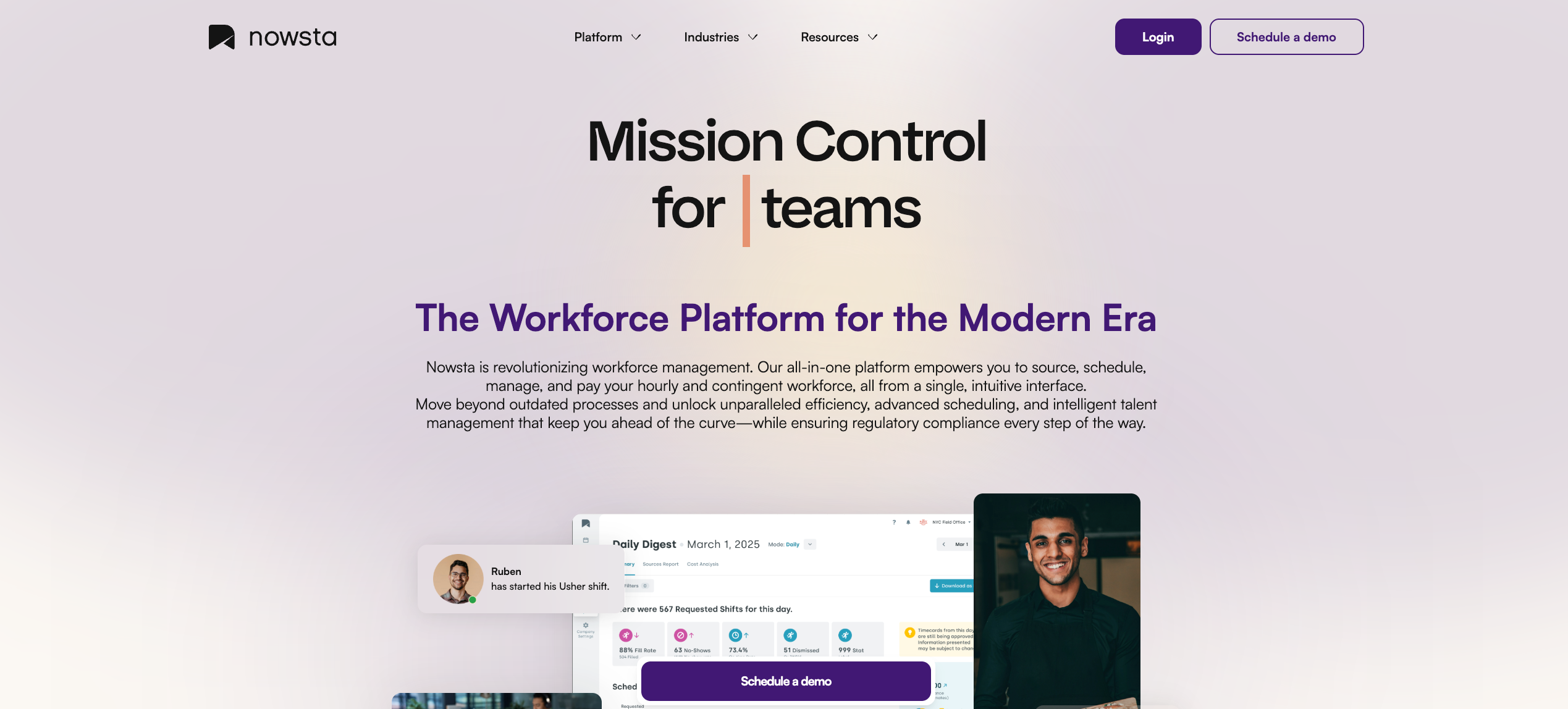
Managing overtime compliance starts before anyone clocks out. It starts at the schedule. When you build shifts with visibility into projected hours, you can get ahead of overtime before it happens, not scramble to fix it after the fact.
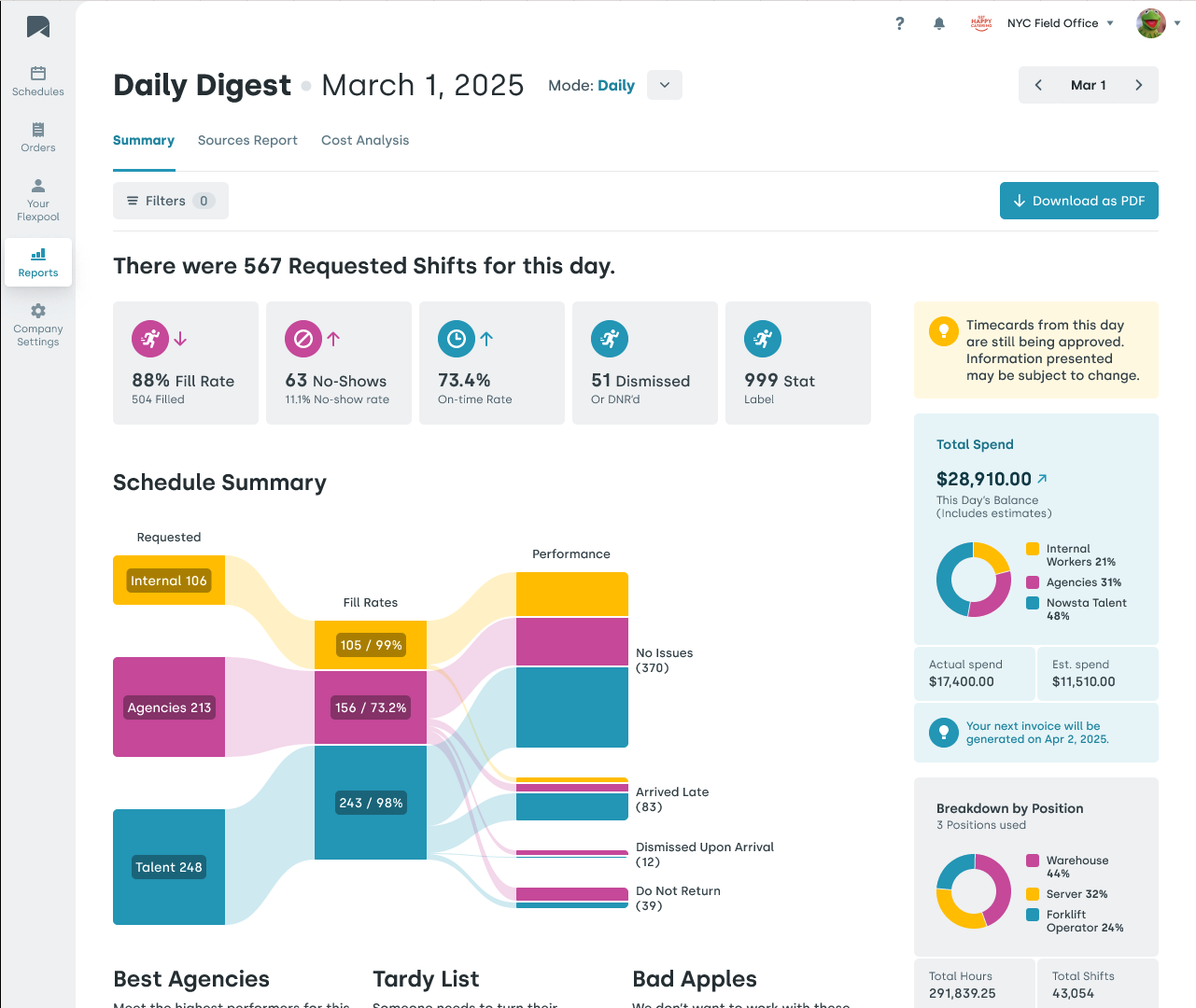
Nowsta’s platform gives operations teams:
- Real-time time and attendance tracking with geofencing, so every overtime hour is captured accurately
- Automated alerts when workers approach or exceed 40 hours, letting managers act before overtime starts
- Seamless payroll integrations that pull verified hours directly into your payroll process, reducing manual errors that could misreport overtime earnings
- Centralized workforce visibility so you always know who’s working, how many hours they’ve logged, and what it’s costing you
Why Accurate Tracking Is Now a Tax Issue
Starting in 2026, employers must separately report overtime pay on tax forms. That means the data needs to be clean, separated, and auditable. If your time-tracking system can’t distinguish the overtime premium from regular wages, you’ve got a compliance gap.
Teams using Nowsta cut scheduling time by 80% and see a 28% reduction in no-shows, which means fewer last-minute gaps that drive unplanned overtime work in the first place. That’s not just operational efficiency. It’s a direct impact on your labor costs and your compliance posture.
Pro tip:The best way to manage overtime tax obligations is to reduce unnecessary overtime hours through smarter scheduling, while making sure every legitimate overtime hour is tracked and reported correctly. Nowsta helps on both fronts.
Whether you’re managing 50 hourly workers or 500, having a platform that tracks overtime hours precisely and connects to payroll isn’t a luxury anymore. Given what the IRS now requires employers to report, it’s the baseline.
Stop Letting Overtime Catch You Off Guard. Nowsta Has You Covered.
Overtime tax law just got more complex, and the window to get your systems right is closing. Whether your team logs a handful of extra hours or runs on shift-based schedules year-round, understanding how overtime affects your payroll, your employees’ tax returns, and your compliance obligations is no longer optional.
Key takeaways from this article:
- Overtime is not taxed at a higher rate. It gets added to your total income and taxed at your regular bracket
- The new no tax on overtime deduction (2025–2028) lets eligible workers deduct up to $12,500 (or $25,000 for joint filers) of their overtime premium from federal taxable income
- Only the FLSA-required overtime premium qualifies, not total overtime pay
- FICA taxes and Medicare taxes still apply regardless of the deduction
- Starting in 2026, employers must separately report overtime pay on W-2s and other tax forms
- Accurate time tracking and correct employee classification are now directly tied to tax compliance
The teams that manage overtime well aren’t just saving money on labor costs. They’re protecting themselves from compliance gaps that get expensive fast.
Nowsta gives you the real-time visibility, automated alerts, and payroll integrations to stay ahead of every hour worked, every shift scheduled, and every reporting requirement the IRS throws your way. Less scrambling at tax season. More control, year-round.
Struggling to keep overtime costs compliant? Nowsta automates overtime tracking and flags thresholds before they become problems. Schedule a demo.
FAQs
Are bonuses taxed at 22% or 40%?
Bonuses are typically withheld at a flat 22% supplemental rate under federal law for amounts under $1 million. They don’t carry their own permanent rate at filing. They fold into your total income on your federal tax return, where your actual bracket applies. Many workers owe taxes or receive refunds depending on how their total annual income lands.
How much tax do you pay on overtime hours?
There’s no fixed rate. Overtime pay is taxable as ordinary income, so overtime affects your tax bill based on your total earnings and filing status. The more you earn overall, the higher the bracket your overtime hours push you into. The new overtime bill introduced a deduction that reduces the impact for certain workers from 2025 through 2028.
At what point is overtime not worth it?
It depends on how overtime affects your modified adjusted gross income and which tax bracket you land in. For most hourly workers, overtime earnings still net positive even after taxes. The no tax on overtime deduction adds meaningful tax savings for qualifying workers. If you’re unsure how it stacks up against your other deductions, tax professionals can give you a clearer picture based on your filing status.
Is overtime taxed at a higher rate?
No. Overtime explained simply: it’s taxed at your existing income tax rate, not a penalty rate. When it feels taxed differently, it’s because overtime pushes your projected annual income higher within a pay period, which increases temporary withholding. Your federal tax return corrects this at year-end based on your actual total income.
Why am I being taxed on my overtime pay?
Because overtime pay is taxable under federal law, treated the same as regular pay for withholding purposes. How does no tax on overtime work, then? It doesn’t eliminate withholding during the year. Eligible non-exempt employees claim a deduction when they file, which reduces their federal taxable income.