Your scheduling process is bleeding money. And the worst part? Most operations leaders don’t see it happening. One Midwest manufacturing facility calculated it was spending 19,741 man-hours annually just maintaining its manual scheduling process. That’s not a typo. That’s nearly 10 full-time employees dedicated to managing a spreadsheet.
If your team is still building schedules by hand, you’re not saving money. You’re hiding costs. This article breaks down exactly where those dollars go and what to do about it.
Here’s what we’ll cover:
- The real (and often invisible) cost of manual scheduling at scale
- How overtime spirals when you lack real-time workforce visibility
- Why spreadsheets fail at compliance and labor law management
- The connection between poor scheduling and employee turnover
- What AI-powered scheduling actually fixes (and what it doesn’t)
- How to calculate the ROI of switching to automated workforce orchestration
Platforms such as Nowsta are built for exactly this problem. It’s an all-in-one workforce orchestration platform that helps enterprise teams schedule, manage, and pay their hourly and contingent workers. Everything runs from a single interface.
The Real Cost of Manual Scheduling
Most operations leaders think scheduling is just “part of the job.” It’s not. It’s a cost center hiding in plain sight.
When your team builds schedules using spreadsheets, emails, and phone calls, the price tag goes far beyond the hours spent toggling between tabs. Eighty percent of employee timesheets in the U.S. contain errors. Every one of those errors creates a ripple effect: payroll miscalculations, compliance violations, and overtime you never approved.
Where the Money Actually Goes
Here’s what manual scheduling really costs at enterprise scale:
- Administrative time. Mid-sized operations can burn through 10 to 15 hours per week just creating, adjusting, and redistributing schedules. That’s a part-time employee doing nothing but managing a spreadsheet.
- Error-driven overtime. Human error rates in manual scheduling hover between 10 and 30 percent, and those mistakes lead to last-minute coverage gaps that get filled with overtime pay at 1.5x the standard rate.
- Payroll processing bloat. Manual payroll systems cost roughly $15 per hour to process, compared to about $2 per hour with automated alternatives. At 250+ employees, that gap becomes a six-figure problem fast.
Pro tip: If you can’t tell your CFO exactly how much scheduling errors cost last quarter, that’s the problem. You’re flying blind.
It Compounds as You Scale
Manual scheduling doesn’t just stay expensive. It gets more expensive with growth. As locations and headcount increase, missed shifts and overlapping coverage compound, draining both budget and team morale.
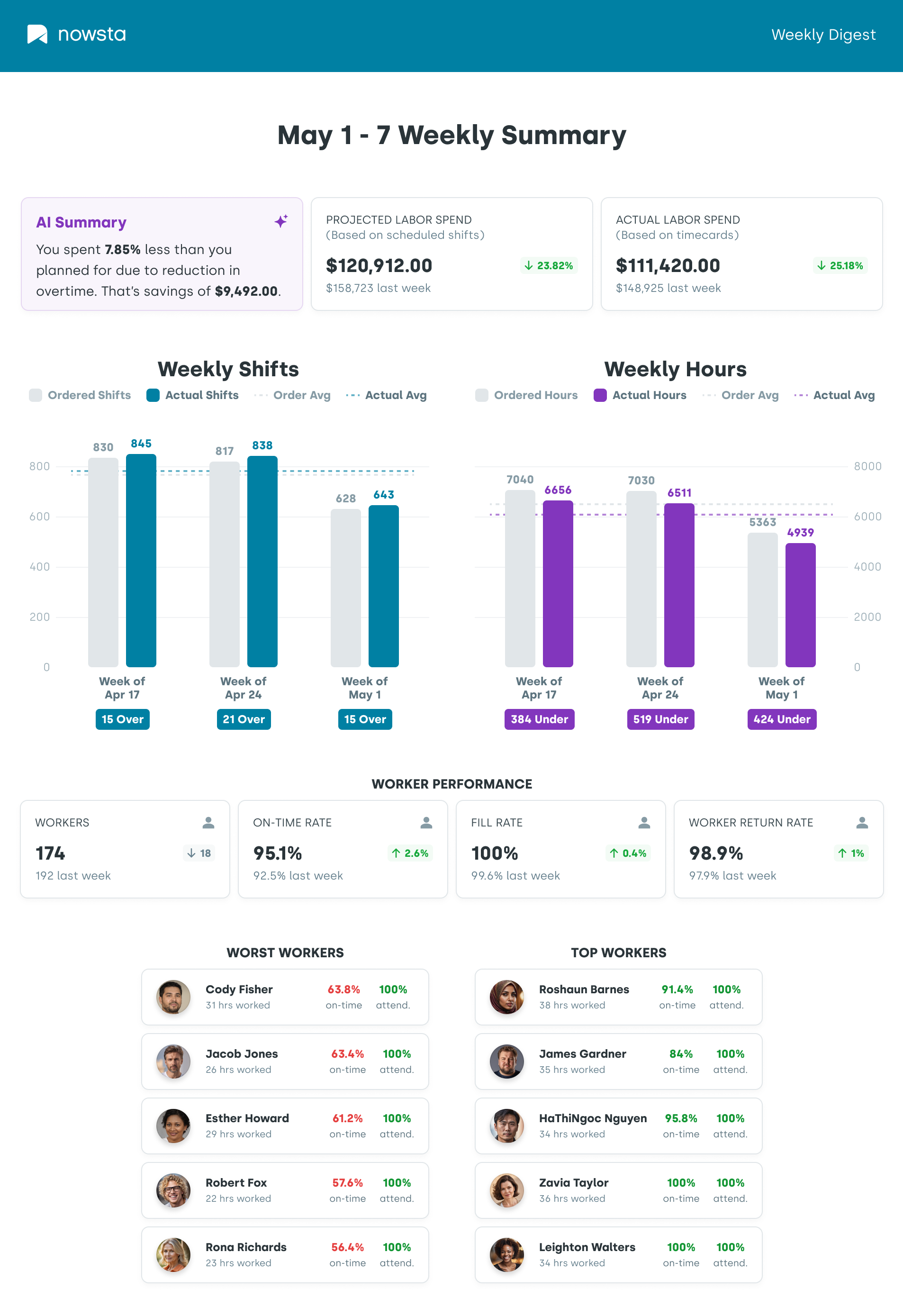
This is where Nowsta changes the equation. Its AI-powered scheduling engine builds optimized schedules in minutes, cutting scheduling time by up to 80% and giving operations teams real-time visibility into labor costs before they spiral.
How Overtime Spirals Without Visibility
Overtime doesn’t start as a budget crisis. It starts as a single coverage gap on a Tuesday afternoon.
Someone calls out sick. A manager scrambles to fill the shift. They grab the first person available, not the most cost-effective one. That employee is already at 38 hours. Two hours later, you’re paying time-and-a-half for a shift that should have cost you straight time. Multiply that across dozens of locations and hundreds of employee hours, and the overtime costs compound into something ugly.
This is the core problem with manual systems. They operate on reaction, not prevention.
Why You Can’t Fix What You Can’t See
When operations teams manage schedules through spreadsheets and email threads, they lose real-time visibility into three critical data points:
- Who’s approaching overtime thresholds. Without real-time monitoring, managers don’t know an employee is at 39 hours until the payroll mistakes have already been made.
- Where coverage gaps exist right now. Manual processes create operational delays between a callout and a replacement. That delay almost always results in overtime hours for whoever picks up the slack.
- What labor costs look like before the schedule is published. If you can’t see the financial impact of a schedule before it goes live, you’re just guessing.
The most common causes of unnecessary overtime include failure to anticipate demand, outdated workforce management systems, and lack of real-time operational visibility. These aren’t edge cases. They’re the default state of any enterprise still relying on manual methods.
Pro tip:If your managers are finding out about overtime after timesheets are submitted, the damage is already done. You need alerts that fire before a shift pushes someone over the threshold.
The Domino Effect on Operational Costs
Here’s the part that rarely makes it into budget meetings. Overtime doesn’t just inflate payroll. It triggers a chain of hidden costs:
- Burnout and lost productivity. Overworked employees make more errors, work slower, and disengage faster. That’s lost revenue hiding behind a timesheet.
- Compliance risks. Uncontrolled overtime hours can violate labor regulations you didn’t even know applied to your workforce. The Fair Labor Standards Act requires 1.5x pay for non-exempt employees working over 40 hours, and in FY 2024 alone, the Department of Labor recovered nearly $150 million in back wages tied to FLSA violations.
- Coverage gaps breed more overtime. When burnt-out employees call out, someone else works overtime to cover them. The cycle feeds itself.
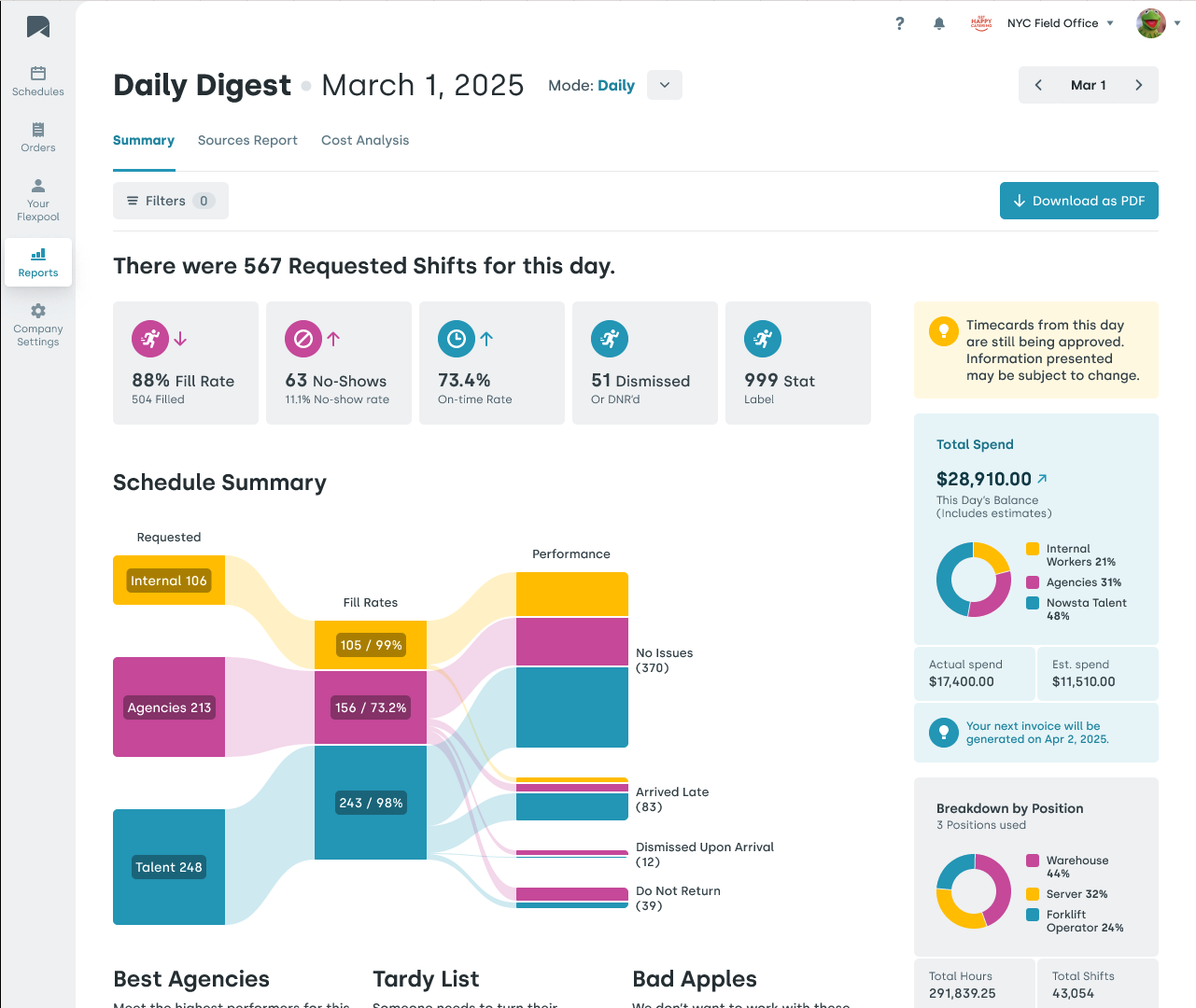
Nowsta solves this with real-time data baked into every scheduling decision. Its AI-powered engine shows managers exactly what each shift costs in labor before it’s published. If someone is approaching an overtime threshold, the platform flags it automatically and suggests a more cost-effective replacement. No spreadsheets. No guesswork. Just real-time monitoring that prevents costly errors before they happen.
Why Spreadsheets Fail at Compliance
Let’s be blunt. A spreadsheet doesn’t know what the Fair Labor Standards Act is. It doesn’t track overtime thresholds across multiple states. It won’t alert you when a schedule violates meal break requirements in California or predictive scheduling laws in New York City.
And yet, most enterprise operations teams still use manual data entry to manage compliance across their workforce. That’s not a process. That’s a liability.
The Compliance Landscape Keeps Shifting
Labor laws in the U.S. are not static. They change at the federal, state, and city level, sometimes within the same calendar year. Consider what operations teams are currently navigating:
- Overtime classification rules. The 2024 attempt to raise the FLSA salary threshold was vacated by a federal court, reverting thresholds to 2019 levels. But many states have their own overtime rules that may differ.
- Predictive scheduling ordinances. Cities like Chicago, New York, and San Francisco now require advance notice of schedules, penalties for last-minute changes, and precise records of every shift modification.
- Paid leave expansion. Multiple states launched new family and sick leave programs in 2025, each with unique accrual rates, usage caps, and rollover rules.
Manual scheduling can’t keep up. When your compliance strategy depends on a manager remembering to check a regulation before creating schedules, you’re building audit readiness on a foundation of human error.
What a Compliance Failure Actually Costs
This isn’t theoretical. Here’s what incorrect data entry and scheduling errors can trigger:
| Violation Type | Potential Impact |
|---|---|
| Unpaid overtime | Back wages + liquidated damages (double the owed amount) |
| Missed meal/rest breaks | Per-employee penalties per violation, per pay period |
| Predictive scheduling violations | Fines + premium pay to affected workers |
| Misclassification of exempt status | Class action exposure + DOL investigation |
Penalties for willful or repeated FLSA violations now reach $2,515 per offense. For an enterprise with hundreds of employees across multiple states, even a handful of scheduling errors can generate significant costs fast.
Pro tip: If you can’t produce a complete audit trail of schedule changes, shift swaps, and overtime approvals within minutes, you’re not audit-ready. Period.
Nowsta’s built-in compliance features eliminate this risk at the source. The platform automatically enforces labor regulations, tracks overtime thresholds in real time, and maintains precise records of every schedule change. When laws shift, the system adapts. Your spreadsheet won’t.
Scheduling’s Impact on Employee Turnover

You can throw money at employee retention all day. Better pay. Better benefits. Better snacks in the break room. But if your scheduling process is chaotic, unpredictable, and unfair, people will leave.
About one in four U.S. employees face schedule unpredictability and instability, and roughly four in ten have little or no control over their work schedules. That’s not a minor inconvenience. That’s a workforce-wide retention problem.
The Direct Link Between Schedules and Exits
According to Gallup, 42% of employee turnover is preventable. Nearly a quarter of that preventable turnover could be avoided if managers addressed problems with staffing, workload, or scheduling.
Think about what manual scheduling looks like from the employee’s perspective:
- Schedules posted last-minute, making it impossible to plan childcare or second jobs
- Unfair distribution of desirable vs. undesirable shifts
- Constant changes with zero communication
- No self-service features to request swaps or time off digitally
Each of these friction points chips away at employee satisfaction. And when people leave, the costs compound. You’re not just losing a worker. You’re absorbing recruiting costs, onboarding time, lost productivity during the ramp-up, and the strain on the team members who pick up the slack.
The Math on Turnover Nobody Wants to Do
The average total employer turnover rate in 2024 was 18%. For industries like catering, events, and quick-service restaurants, it’s often much higher. The good news is that around 75% of voluntary employee turnover is preventable.
The question is whether your existing processes are set up to prevent it, or whether they’re actually causing it.
| Turnover Cost Factor | Estimated Impact |
|---|---|
| Recruiting and hiring a replacement | 50-200% of the employee’s annual salary |
| Lost productivity during vacancy | 1-3 months of reduced output |
| Training and onboarding | 30-90 days before full employee productivity |
| Team morale and coverage gaps | Increased overtime + burnout for remaining staff |
Nowsta directly addresses the scheduling-driven causes of turnover. Its mobile-first platform gives workers self-service features to view schedules, request time off, and claim open shifts from their phones. Managers get a drag-and-drop builder that ensures fair distribution of shifts. And with automated notifications, your team always knows what’s coming, which builds the trust and transparency that keep people around.
What AI Scheduling Fixes (and Doesn’t)
AI-powered scheduling is not magic. It won’t fix a broken company culture, and it can’t manufacture workers who don’t exist. But what it does fix is substantial, measurable, and often underestimated.
Let’s separate the signal from the noise.
What Automated Scheduling Actually Solves
- The time spent creating schedules drops dramatically. Instead of managers burning 10+ hours per week on manual effort, AI-powered tools like Nowsta build optimized schedules in minutes. That’s not marketing fluff. Nowsta’s platform reduces scheduling time by up to 80%, giving operations teams their valuable time back for more strategic initiatives.
- Overtime costs become controllable. Automated systems track employee hours in real time and flag potential overtime before shifts are assigned. This alone eliminates one of the biggest hidden costs of manual scheduling.
- Compliance risks shrink. The platform enforces labor laws automatically. No more relying on a manager’s memory to catch a scheduling violation. Nowsta maintains precise records and adapts to changing labor regulations so your team stays compliant without manual intervention.
- Coverage gaps get filled faster. When someone calls out, Nowsta’s AI-powered recommendations identify the best available replacement based on skills, availability, certifications, and cost. No more frantic text chains. No more filling gaps with whoever answers the phone first.
- Data replaces gut feelings. With real-time data on labor costs, attendance trends, and workforce productivity, operations teams can make scheduling decisions based on evidence, not instinct. That’s a competitive advantage most enterprises are leaving on the table.
What It Won’t Fix
Let’s be honest about the limitations:
- Software innovations don’t replace leadership. If managers aren’t trained to use the platform or don’t trust the data, adoption stalls. Change management matters.
- Garbage in, garbage out. If your employee data is outdated or incomplete, even the best automated workflows will produce flawed results. Clean data entry is a prerequisite.
- It won’t eliminate all upfront costs. There’s an initial investment in implementation, training, and integration with your existing payroll and HR systems. The cost savings are real, but they take time to materialize.
- Culture problems need human solutions. AI can optimize shift fairness and improve accuracy, but if employees are disengaged for reasons beyond scheduling, that requires a separate conversation.
Pro tip:The biggest missed opportunities with scheduling software come from underutilization. Don’t just use it for creating schedules. Use demand forecasting, labor analytics, and compliance tracking to get the full ROI.
The Bottom Line
Automated scheduling doesn’t promise perfection. It promises fewer costly errors, faster decisions, and real-time monitoring across your entire workforce. For enterprises still running on outdated systems and manual processes, that’s not a marginal improvement. It’s a fundamental shift in operational efficiency.
Calculating the ROI of Workforce Orchestration

If you’re going to make the case for switching from manual scheduling to an automated platform, you need numbers. Not vague promises. Not “we’ll save time.” You need a framework your CFO can take to the next board meeting.
Here’s how to build it.
The ROI Formula
At its simplest:
ROI (%) = (Total Annual Benefits – Total Annual Costs) ÷ Total Annual Costs × 100
But the real work is in quantifying those benefits accurately. Most enterprises undercount the savings because they only look at the obvious line items and ignore the hidden costs of manual scheduling.
Step 1: Quantify Your Current Manual Scheduling Costs
Start by auditing what your current manual processes actually cost. Be specific:
- Manager time spent on scheduling. How many hours per week do your managers spend creating schedules, handling shift swaps, and managing overtime? Multiply that by their hourly rate.
- Overtime overspend. What’s the gap between your planned overtime and actual overtime? That delta is the cost of poor scheduling efficiency.
- Error correction and payroll mistakes. How much time and money does your team spend on administrative overhead related to scheduling errors, incorrect data entry, and dispute resolution?
- Turnover-related expenses. What does it cost to replace an employee who leaves due to dissatisfaction with scheduling? Include recruiting, training, and lost productivity.
- Compliance penalties. Have you paid fines, settled disputes, or spent legal fees related to labor law violations in the past 12 months?
Step 2: Estimate the Savings from Automation
Based on industry benchmarks and Nowsta’s proven results:
| Savings Category | Estimated Impact |
|---|---|
| Scheduling time reduction | Up to 80% fewer hours spent managing schedules |
| Overtime cost reduction | 20-35% decrease in unnecessary overtime expenses |
| No-show reduction | Up to 28% fewer no-shows with automated reminders |
| Payroll processing speed | Up to 90% faster payroll processing |
| Overall labor cost reduction | 15-35% decrease in total labor spend |
Step 3: Factor in the Initial Investment
Be honest about the upfront costs. Implementation, training, integration with existing systems, and ongoing subscription fees all go into the denominator. But here’s the key insight: businesses using scheduling software typically see a positive return on investment within 3 to 6 months, with annual returns reaching 200 to 300% when fully utilized.
Step 4: Include the Intangibles
Some benefits don’t fit neatly into a spreadsheet but absolutely affect your bottom line:
- Employee retention and satisfaction. Reducing turnover by even 5% saves thousands per employee in a high-volume workforce.
- Customer satisfaction. Better-staffed shifts mean better service, fewer errors, and stronger customer relationships.
- Audit readiness. Having precise records and automated compliance tracking saves countless hours of administrative tasks and protects you from costly errors.
- Sustainable growth. As you scale locations and headcount, a platform like Nowsta scales with you. Spreadsheets don’t.
Pro tip:Don’t just calculate the ROI of switching. Calculate the cost of not switching. Every month you stay on manual methods, you’re paying the hidden tax of lost productivity, unnecessary expenses, and missed opportunities.
For operations leaders ready to see what the numbers look like for their specific workforce, Nowsta offers a custom demo that walks through exactly how the platform would reduce costs, enhance efficiency, and improve accuracy across your operation.
Stop the Overtime Leak With Nowsta
Manual scheduling isn’t just outdated. It’s quietly draining your budget through overtime spirals, compliance risks, and preventable turnover. If your operations team is still relying on spreadsheets, you’re paying a hidden tax on every shift.
Here are the key takeaways:
- Manual scheduling costs scale exponentially as your workforce grows
- Lack of real-time visibility is the single biggest driver of uncontrolled overtime
- Spreadsheets are fundamentally incapable of managing multi-state compliance
- Poor scheduling practices directly fuel employee turnover
- AI-powered scheduling delivers measurable ROI within 3 to 6 months
- The cost of not switching compounds every month you wait
Nowsta is built for operations leaders who are done watching money disappear into broken schedules. From AI-powered scheduling and real-time labor tracking to built-in compliance and seamless payroll integration, it’s the workforce orchestration platform that turns your biggest cost center into a competitive advantage.
How much is manual scheduling actually costing you? Nowsta automates shift creation, flags overtime risks in real time, and cuts labor costs by up to 35%. Schedule a demo and see what your operation looks like without the bleeding.
FAQs
What Is One Challenge of Manual Scheduling?
The biggest challenge is that manual scheduling is inherently error-prone. Every schedule built by hand introduces the risk of manual errors, from double-booking employees to accidentally pushing someone into overtime. These mistakes create coverage gaps, inflate labor costs, and pull managers away from more strategic initiatives to fix problems that shouldn’t exist in the first place.
How Does Overtime Affect Labor Costs?
Overtime inflates labor costs far beyond the time-and-a-half pay rate. It triggers higher payroll taxes, increases workers’ compensation premiums, and accelerates employee burnout, which leads to more callouts and more overtime. Left unchecked, it creates a cycle where routine tasks that should cost standard wages end up costing 1.5x to 2x more simply because scheduling wasn’t optimized.
What Is the Typical Overtime Cost Per Hour?
Under the Fair Labor Standards Act, overtime costs a minimum of 1.5 times the employee’s regular hourly rate. For a worker earning $25 per hour, that’s $37.50 per overtime hour. But the true departmental cost is higher when you factor in payroll taxes, benefits overhead, and the lost productivity that comes with fatigued workers. Most estimates put the real cost at 1.7x to 2x the base rate.
Can Automated Scheduling Improve Timely Project Completion?
Yes. When shifts are properly staffed with the right people at the right times, work gets done on schedule. Manual methods slow everything down because managers spend hours on administrative tasks instead of operational execution. Automated scheduling eliminates that drag, ensures adequate coverage, and gives teams the structure they need for timely project completion without relying on last-minute overtime fixes.