Workday is one of the most recognized names in enterprise HR software. It’s powerful, comprehensive, and built for large enterprises with complex organizations and deep budgets. But it’s also expensive, slow to implement, and comes with a steep learning curve that frustrates HR teams and employees alike.
Workday’s software fees range from $34 to $42 per employee per month for companies at scale, with implementation fees often matching 100% of the annual software cost. For many mid-sized companies and growing operations, that’s hard to justify, especially when better-fit alternatives exist.
Here’s what we’ll cover:
- Why companies are looking for Workday alternatives in 2026
- The top platforms for HR management, payroll, and workforce management
- What key features to prioritize based on your team size and industry
- A side-by-side comparison of the best workday alternatives
- How to evaluate whether you need a full HCM or a focused workforce management platform
- FAQs about switching from Workday
If your biggest pain point is workforce management for hourly, shift-based, or contingent workers, Nowsta is purpose-built for that. It’s a workforce management platform that combines AI-powered scheduling, time tracking, attendance, and payroll integration into one interface. It fills the exact gap Workday’s enterprise HCM leaves open for frontline teams.
Why Companies Are Looking Beyond Workday
Workday built its reputation as the modern replacement for PeopleSoft. And for years, it delivered. But the HR software landscape has changed dramatically, and many organizations are finding that Workday’s strengths come with significant tradeoffs.
The Core Challenges
- Cost is prohibitive for most. U.S. enterprises can expect annual subscription fees of roughly $400 to $500 per employee for broad Workday deployments at scale, with smaller deals often costing even more per user. Add implementation costs that can range from $500,000 to several million dollars, and you’re looking at a multi-year commitment before you see ROI. There are no transparent pricing pages. No free trials. Just custom pricing conversations where hidden fees surface late in the process.
- Implementation takes months, not weeks. While some Workday competitors can be deployed in two to six weeks, Workday implementations for complex organizations typically stretch across six to twelve months or longer. For HR teams managing employees through rapid growth or seasonal spikes, that timeline is a problem.
- It’s built for enterprise, not for everyone. Workday is designed for enterprise-level companies with more than 1,000 employees. If you’re a medium-sized business or a growing operation with 200 to 1,000 workers, you’re paying enterprise prices for features you may never use. The platform’s depth becomes a liability when your HR tasks are straightforward, and your team needs speed over sophistication.
- Workforce management for hourly workers is an afterthought. Workday excels at core HR, talent management, and financial planning for salaried, knowledge workers. But if your operation runs on hourly, shift-based, or contingent labor, Workday’s scheduling and attendance tracking capabilities fall short. Performance management in Workday lacks the engagement of a dedicated talent management system, and onboarding feels like a series of uninspiring task lists.
- The employee experience has aged. Workday’s first releases were built in Adobe Flash, and while the technology has evolved, critics note the platform now feels older than PeopleSoft was when Oracle acquired it. For HR teams prioritizing employee engagement and a modern user interface, that matters.
The Best Workday Alternatives
Here’s the list of the 9 best Workday alternatives:
1. Nowsta (Best Alternative for Hourly and Contingent Workforce Management)
Best for: Enterprise operations managing hourly, shift-based, and contingent workers across catering, events, QSR, staffing, and hospitality.
Workday is built for salaried employees at desk jobs. Nowsta is built for the other workforce, the hourly, contingent, and shift-based teams that power catering operations, live events, quick-service restaurants, and staffing agencies.
Nowsta is a workforce management platform that combines AI-powered scheduling, time tracking with geofencing, attendance tracking, talent sourcing, and seamless payroll integration into a single interface.
Key features:
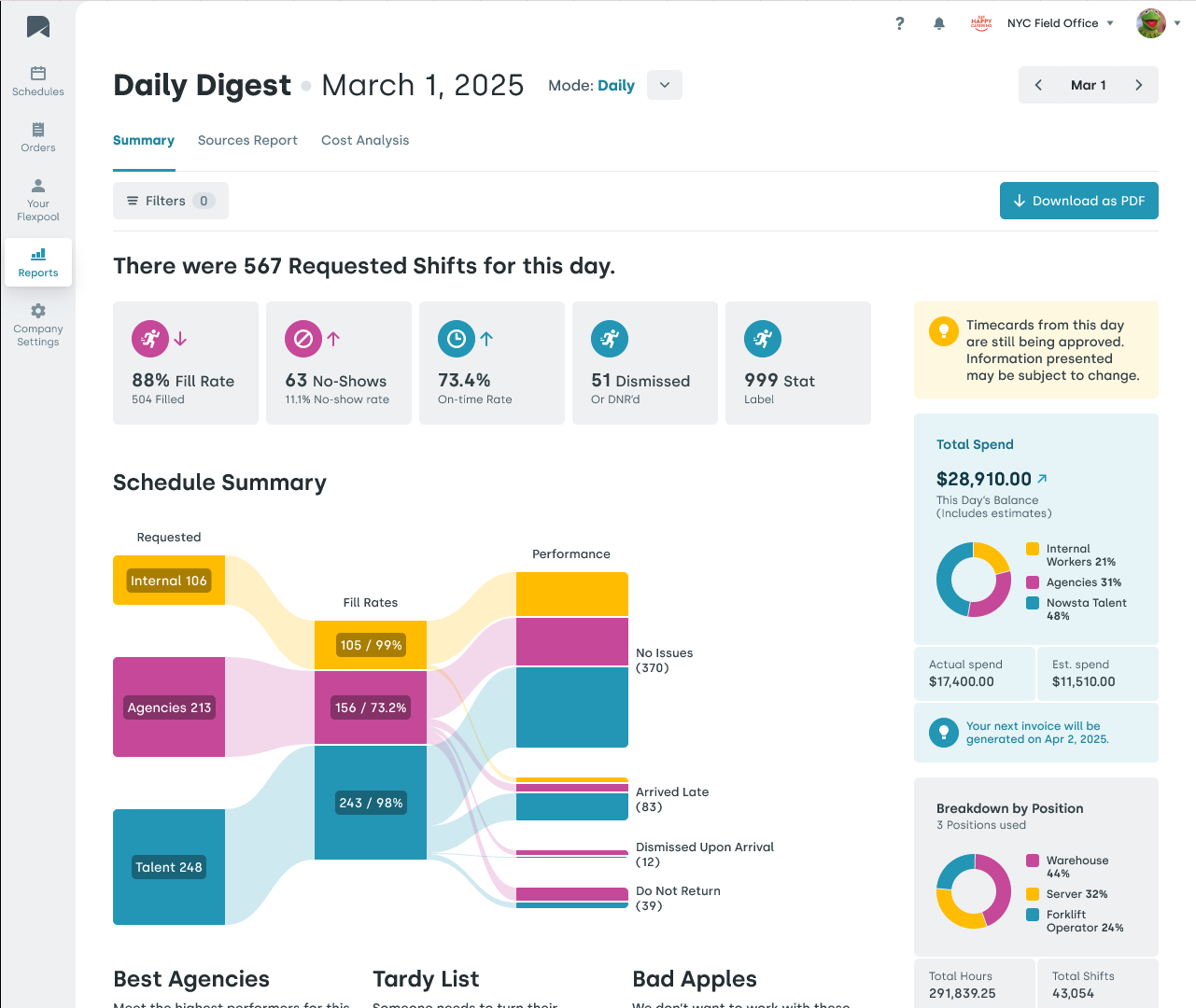
- AI-powered scheduling that reduces scheduling time by up to 80% and controls labor costs in real time
- Built-in time tracking and attendance tracking with geofenced clock-in/clock-out
- Talent sourcing and employee onboarding with an integrated ATS for hourly, full-time, part-time, and contingent staff
- Automated workflows for shift reminders, no-show alerts, and compliance enforcement
- Mobile-first employee self-service for shift claims, swaps, and time-off requests
- Seamless payroll integration that syncs hours, overtime, and labor costs directly to your payroll platform
- Labor forecasting and real-time labor cost visibility before schedules are published
What sets it apart: Nowsta doesn’t try to be an HCM for everyone. It’s built specifically for the workforce management challenges that Workday ignores: complex scheduling, real-time attendance, labor forecasting, and managing employees across dynamic, shift-based environments. If your operation runs on hourly labor, Nowsta is the best alternative to Workday for the workforce management layer.
2. Rippling (Best All-in-One HR, IT, and Payroll Platform)
Best for: Fast-growing companies that need integrated HR, IT, and finance in a single comprehensive platform.
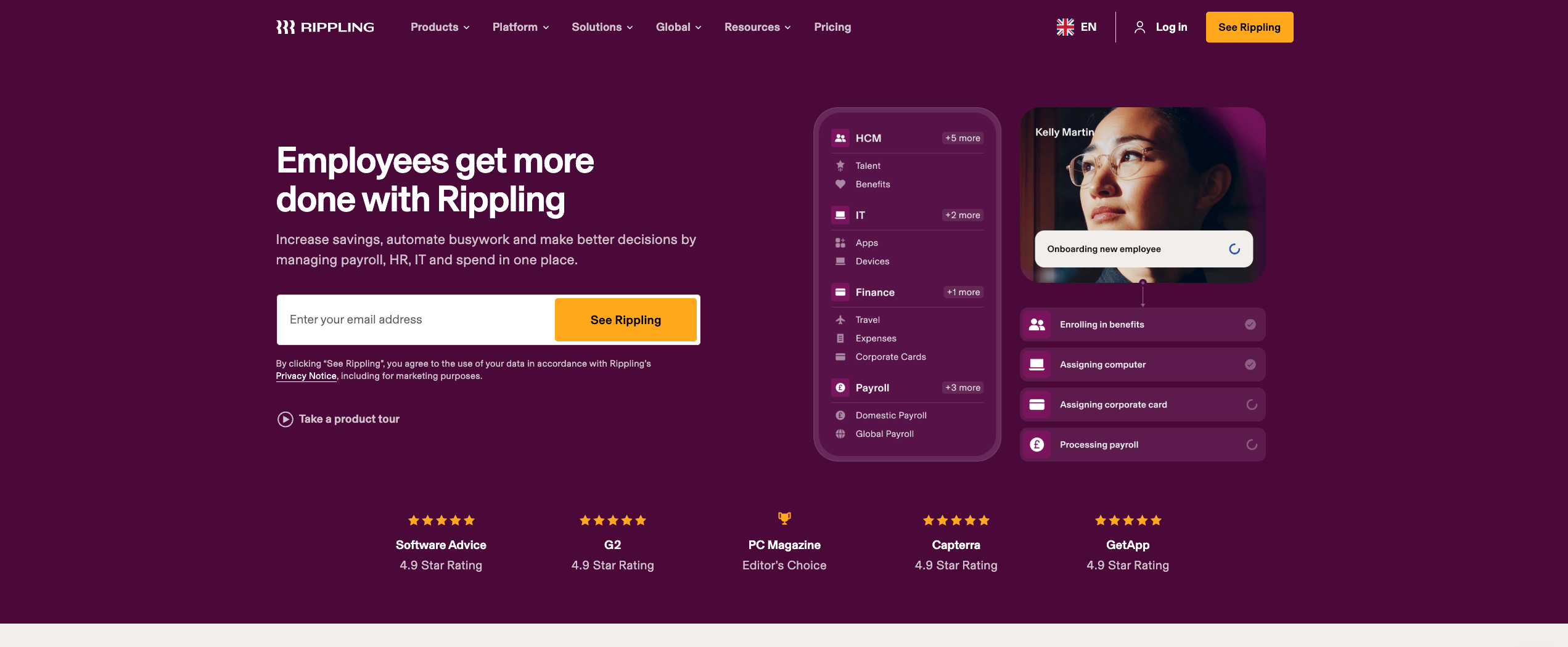
Rippling combines HR management, payroll processing, benefits administration, and IT device management into one system. It’s one of the few Workday competitors that also manages software provisioning, device management, and app access alongside traditional hr processes.
Key features:
- Unified employee data across HR, IT, and finance on the same platform
- Global payroll for international employees across 50+ countries
- Automated employee onboarding and offboarding that provisions devices, software, and benefits in minutes
- Custom workflows and automated workflows triggered by employee lifecycle events
- Benefits administration including health insurance, 401(k), and commuter benefits
- Performance management with continuous feedback and performance reviews
Consideration: Rippling is powerful for tech-forward companies and distributed teams that need HR and IT in one place. However, it’s not built for shift-based scheduling or labor forecasting. If your workforce is primarily hourly, you’d pair Rippling with a dedicated workforce management platform like Nowsta.
3. ADP Workforce Now (Best for Payroll-First Mid-Sized Companies)
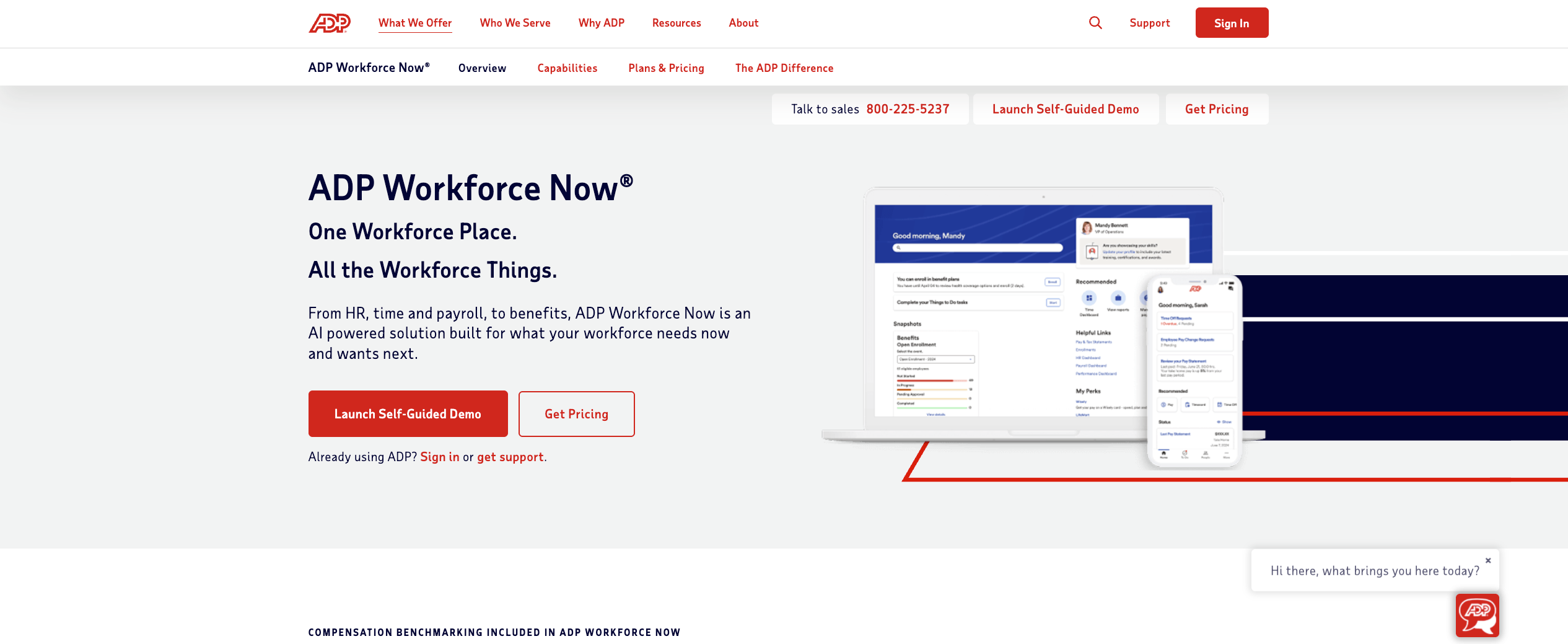
Best for: Mid-sized companies that need rock-solid payroll management, tax compliance, and benefits administration.
ADP Workforce Now is one of the most established workday alternatives for organizations that prioritize payroll above all else. ADP has decades of experience in payroll processing, tax filing, and compliance, making it a safe choice for hr teams at medium-sized businesses.
Key features:
- Comprehensive payroll management with unlimited payroll runs and automated tax filing
- Benefits administration with health insurance, retirement plans, and open enrollment
- Core HR with employee records, document management, and document storage
- Time tracking and attendance tracking integrations
- Talent management, including recruiting, performance tools, and employee onboarding
- Strong compliance features for multi-state and multi-country tax compliance
Consideration: ADP is a payroll platform first and an HCM second. Its hr modules for performance management and employee engagement don’t match dedicated talent management tools. And its scheduling capabilities are basic, which is why operations teams with shift-based workers often supplement ADP with Nowsta for workforce management, labor forecasting, and AI-powered scheduling.
4. UKG Pro (Best Enterprise-Grade Platform for Large Workforces)
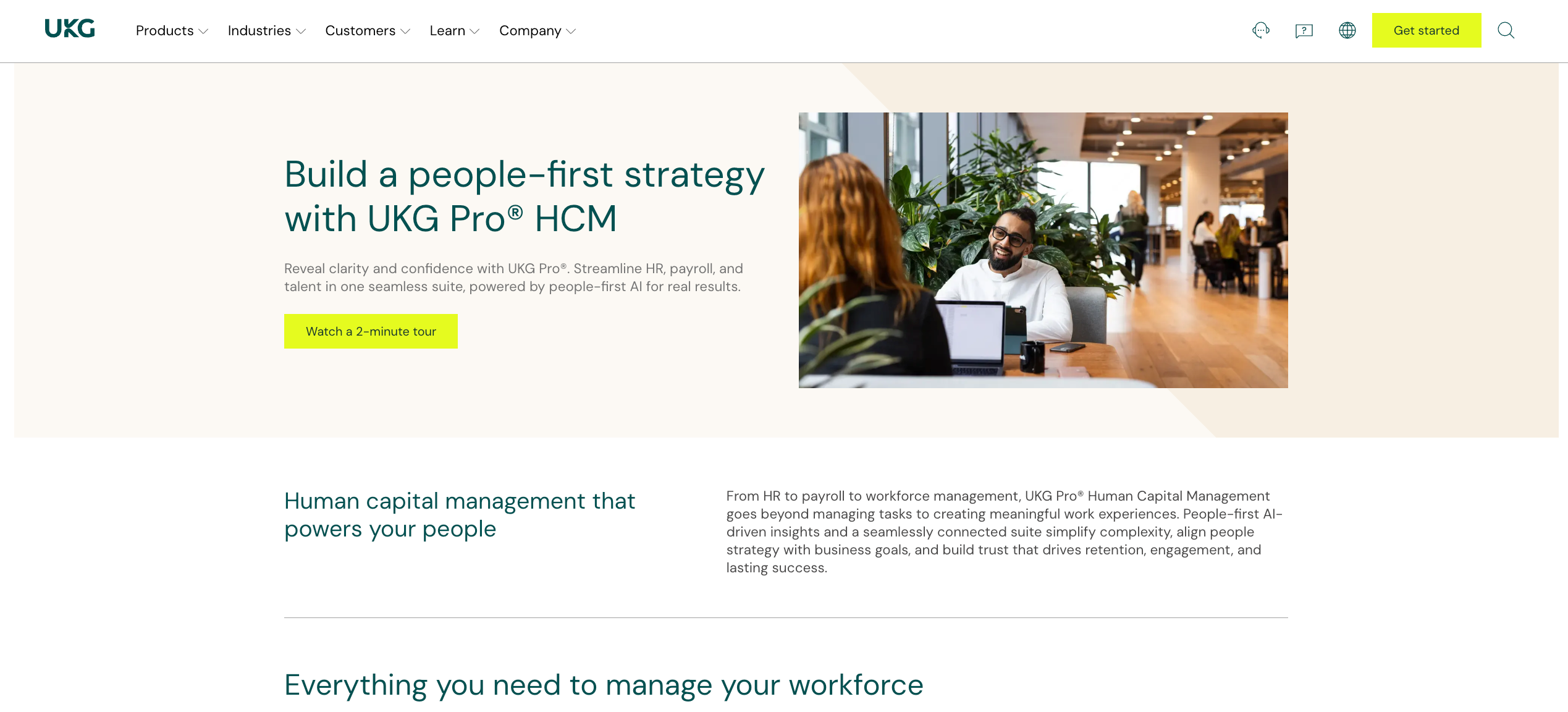
Best for: Large enterprises that need a comprehensive platform covering HR, payroll, talent management, workforce management, and workforce planning.
UKG Pro (formerly Ultimate Software + Kronos) is a direct Workday competitor for large enterprises. It combines a full HCM suite with strong workforce management capabilities, making it one of the few enterprise-grade platforms that handles both salaried and hourly workforces.
Key features:
- End-to-end employee lifecycle management from recruiting through retirement
- Global payroll and complex payroll processing for multi-country operations
- Workforce planning with labor forecasting and demand prediction
- Performance management with continuous feedback, performance reviews, and goal tracking
- Employee engagement tools, including pulse surveys and sentiment analysis
- Advanced analytics with customizable dashboards and predictive insights
Consideration: UKG Pro is powerful but comes with enterprise complexity and custom pricing that can rival Workday’s cost. Implementation timelines are longer than mid-market alternatives. For organizations that need deep workforce management for hourly teams, specifically in catering, events, or staffing, Nowsta provides a faster, more focused solution.
5. BambooHR (Best for Small Businesses and Simple HR Needs)
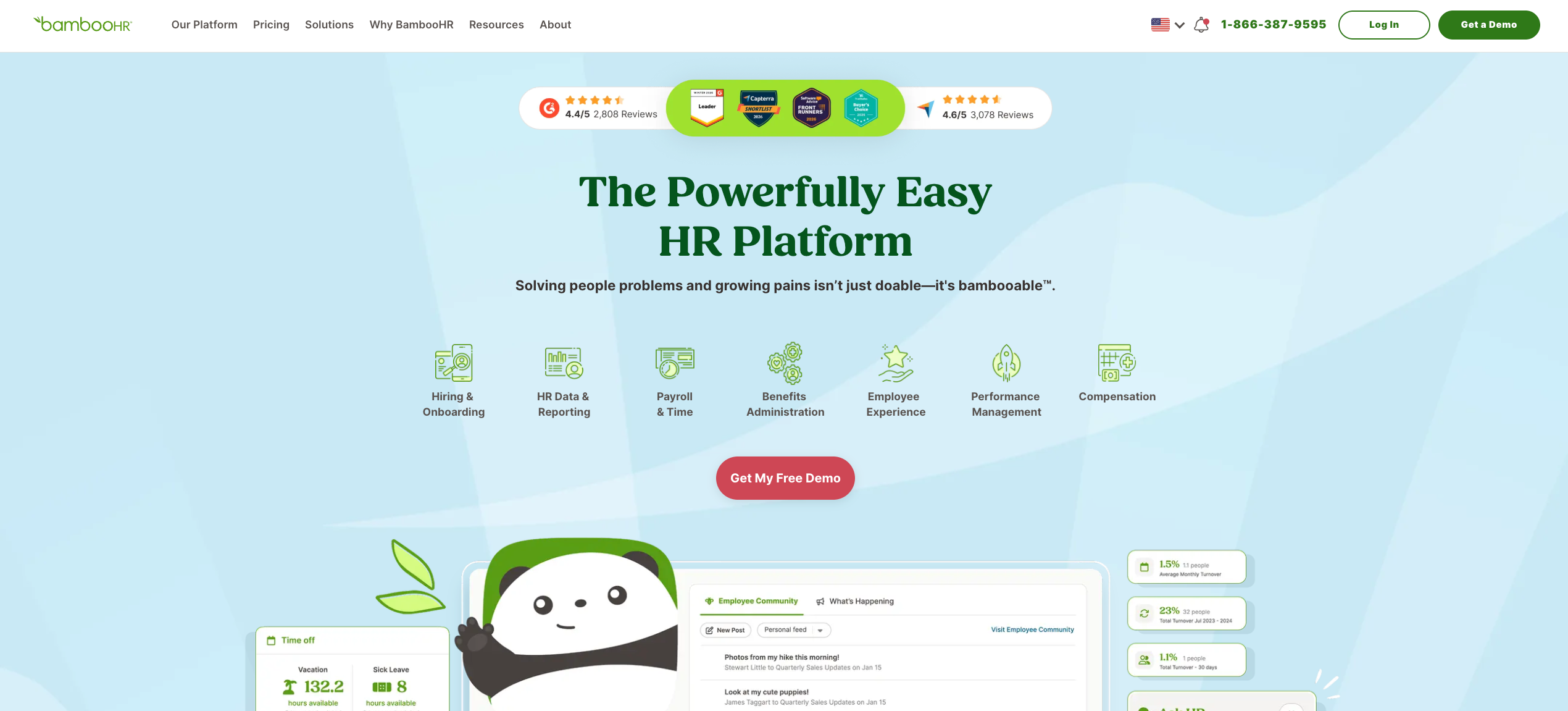
Best for:Small businesses and startups with under 500 employees that need user friendly core HR without enterprise complexity.
BambooHR is the go-to hr solution for small businesses that want to move beyond spreadsheets without the steep learning curve of enterprise platforms. It focuses on making hr tasks simple: managing employee data, running payroll, tracking time off, and handling employee onboarding.
Key features:
- Clean, user-friendly interface with minimal training required
- Core hr including employee records, org charts, and document storage
- Payroll processing with tax filing for U.S.-based teams
- Time tracking and PTO management
- Performance management with basic performance reviews and goal setting
- Employee self-service portal for personal information and benefits
- Applicant tracking and basic hr tools for recruiting
Consideration: BambooHR is not built for complex organizations or global workforce management. It lacks global payroll, advanced analytics, and the workforce planning capabilities that larger teams need. It also has limited scheduling functionality, so operations with hourly workers would need a dedicated workforce management platform like Nowsta alongside it.
6. Deel (Best for Managing a Global Workforce and International Employees)
Best for: Companies hiring international employees and contractors across multiple countries who need an employer of record EOR solution.
Deel solves the specific problem of hiring and managing employees globally without establishing legal entities in every country. It’s not a traditional HCM; it’s a global payroll and compliance platform built for remote teams and distributed teams.
Key features:
- Employer of record EOR services in 150+ countries
- Global payroll that handles complex payroll, tax compliance, and contractor payments in local currencies
- Automated workflows for contracts, invoicing, and compliance documentation
- Employee onboarding for international employees with localized employment agreements
- Payroll data reporting and advanced analytics for global workforce costs
- Self-service portal for employees and contractors to manage payroll data and documents
Consideration: Deel excels at global workforce compliance and contractor payments but lacks core HR features like performance management, employee engagement tools, and workforce planning. It’s best paired with other tools for a complete HR stack.
7. Paylocity (Best Payroll Software for Mid-Sized Companies)
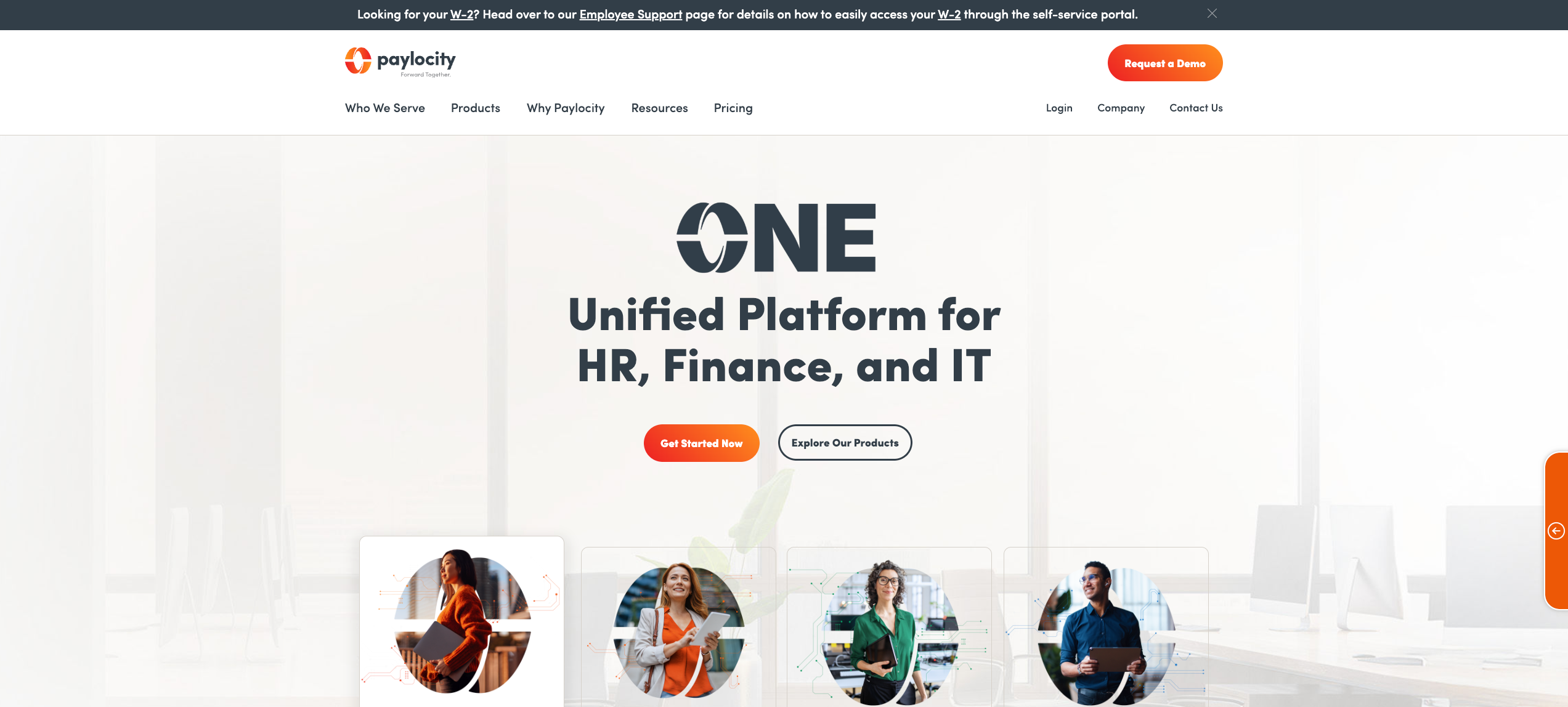
Best for:Mid-sized companies that want strong payroll solutions with solid talent management and employee engagement features.
Paylocity positions itself as a modern alternative to Workday for medium-sized businesses that want payroll, HR, and talent management without enterprise pricing or complexity.
Key features:
- Payroll processing with automated tax filing, garnishment management, and on-demand pay
- Benefits administration and health insurance enrollment
- Performance management with continuous feedback and peer recognition
- Employee engagement tools, including surveys, community feeds, and recognition
- Core hr with employee records, custom workflows, and document management
- Time tracking and attendance tracking with mobile access
- Modern user interface that requires minimal training
Consideration: Paylocity is strong for payroll and employee engagement, but its workforce management and scheduling capabilities are limited. For operations teams managing employees on shifts, pairing Paylocity with Nowsta’s scheduling and labor forecasting fills the gap.
8. SAP SuccessFactors (Best for Large Enterprises Already in the SAP Ecosystem)
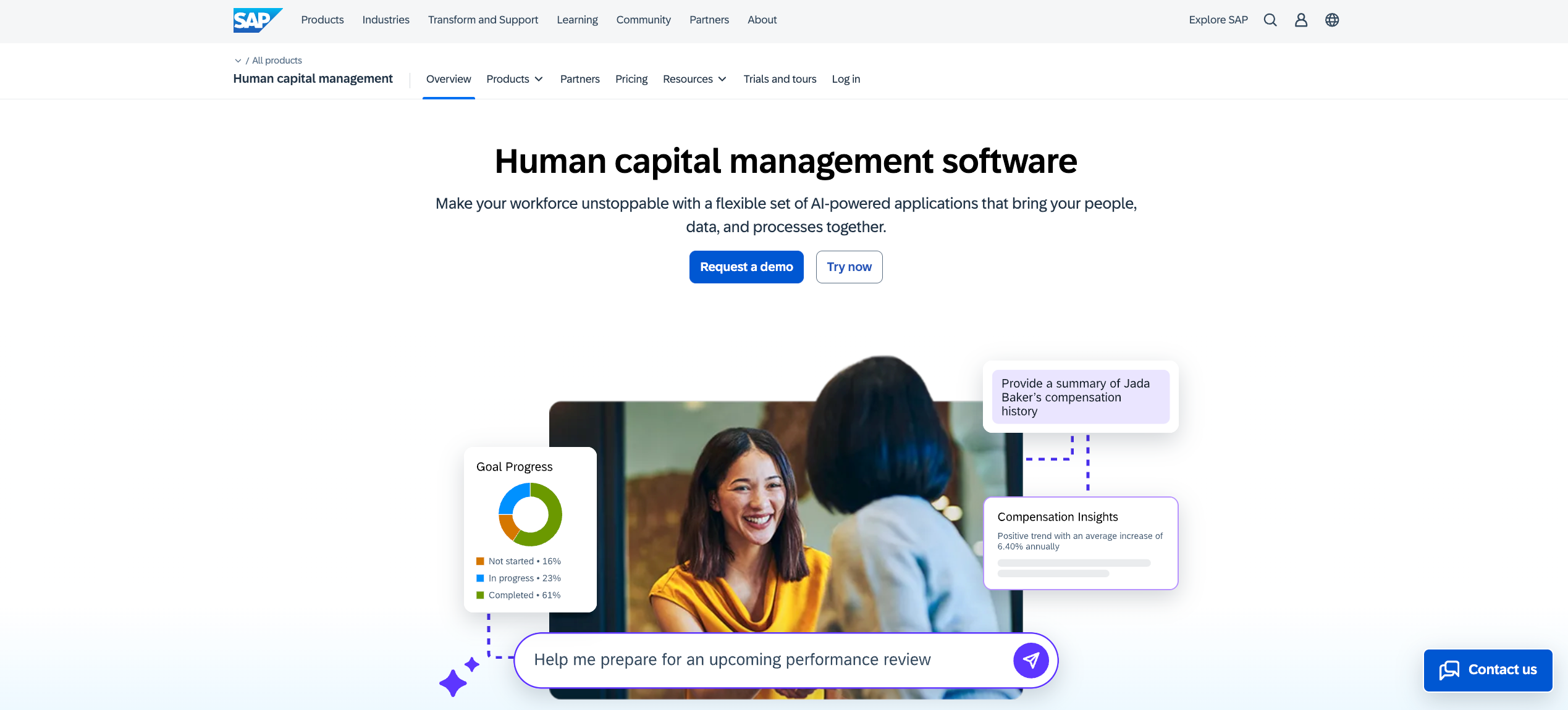
Best for: Global enterprises with 5,000+ employees that already use SAP ERP and need deep integration across HR, finance, and operations.
SAP SuccessFactors is Workday’s most direct competitor at the enterprise level. It offers a comprehensive platform for core hr, talent management, workforce planning, and global payroll that integrates deeply with SAP’s broader ERP ecosystem.
Key features:
- Full talent management suite including recruiting, learning, succession planning, and performance management
- Global payroll for 100+ countries with deep tax compliance
- Workforce planning and advanced analytics with AI-driven insights
- Employee experience tools with continuous feedback and engagement surveys
- Core hr with complete employee lifecycle management
- HR modules that integrate with SAP ERP for finance, procurement, and supply chain
Consideration: SAP SuccessFactors carries the same challenges as Workday: steep learning curve, long implementation timelines, and custom pricing that can be opaque. It’s best suited for complex organizations already invested in SAP. Smaller teams will find it excessive.
9. Gusto (Best Payroll Platform for Small Businesses)
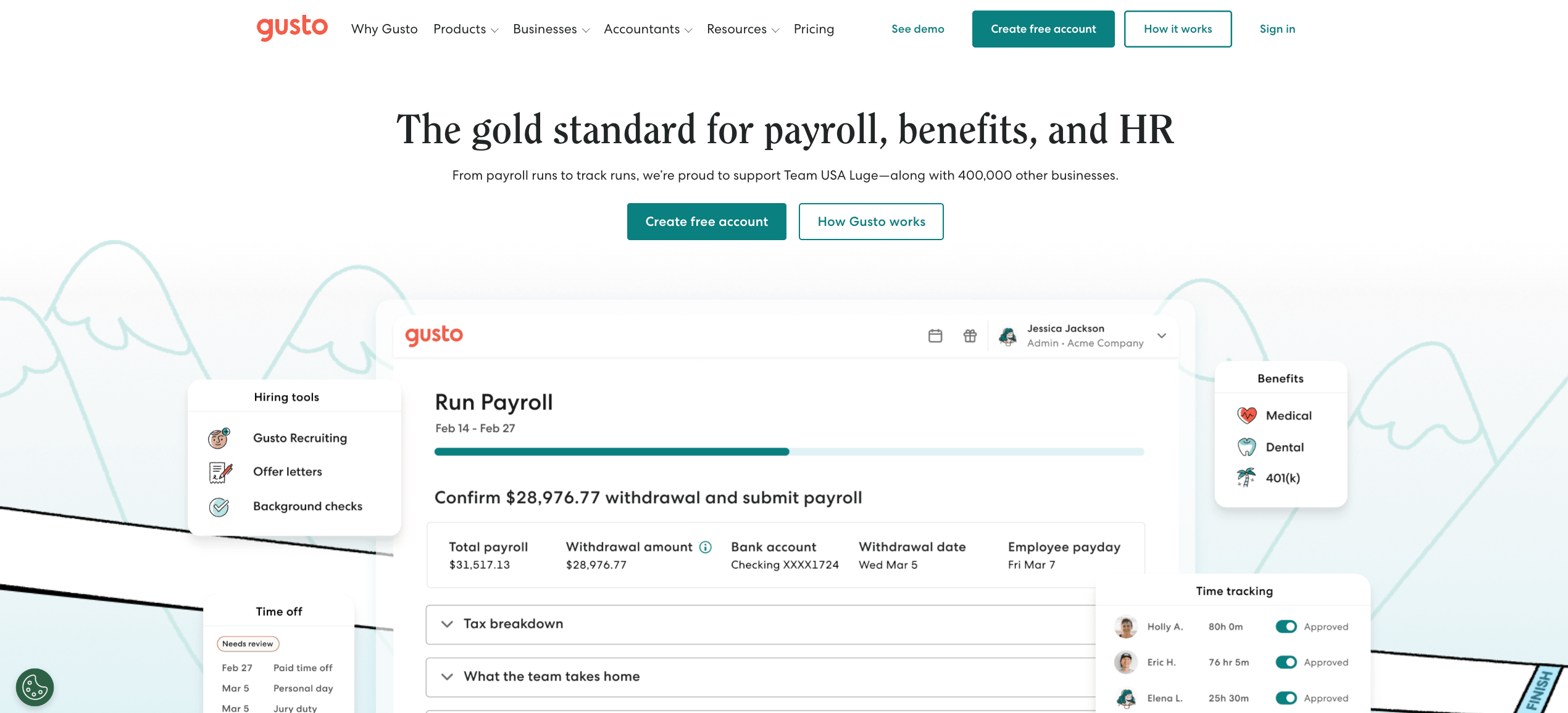
Best for:Small businesses under 100 employees that need simple, affordable payroll software with built-in hr tools.
Gusto is purpose-built for small businesses that need to run payroll, manage benefits, and handle basic hr tasks without hiring a dedicated HR department. It’s often the first alternative to workday that growing companies consider before they need enterprise complexity.
Key features:
- Full-service payroll with automated tax filing and unlimited payroll runs
- Benefits administration including health insurance, 401(k), and workers’ comp
- Employee onboarding with self-service for new hires
- Basic time tracking and PTO management
- Contractor payments with 1099 filing
- Transparent pricing with no hidden fees (paid plans start at $40/month plus $6/employee)
- Integrations with accounting platforms and other tools
Consideration: Gusto is not built for employee performance tracking, advanced features in talent management, or managing a global workforce. It’s a payroll platform for small businesses that pairs well with other specialized tools as you scale.
How to Choose the Right Alternative
The best alternative to Workday isn’t necessarily the platform with the most features. It’s the one that solves your specific problem without introducing the complexity you’re trying to escape.
- If your pain point is managing hourly and contingent workers: Nowsta. Purpose-built for workforce management, scheduling, attendance tracking, and labor forecasting in shift-based environments. No bloated hr modules you don’t need.
- If you need HR, IT, and payroll in one place: Rippling. Especially if you manage distributed teams and need device management and software provisioning alongside integrated hr and payroll management.
- If payroll accuracy and tax compliance are non-negotiable: ADP Workforce Now or Gusto, depending on company size. ADP for mid-sized companies with complex payroll needs; Gusto for small businesses that want simplicity and transparent pricing.
- If you’re a large enterprise replacing Workday 1:1: UKG Pro or SAP SuccessFactors. Both are enterprise-grade platforms with full talent management, global payroll, and workforce planning. Expect similar implementation timelines and custom pricing.
- If you’re hiring internationally: Deel. Best in class for employer of record EOR, global payroll, and contractor payments across 150+ countries.
- If you just need simple HR for a small team: BambooHR. User-friendly, fast to implement, and built for hr teams that want to manage employee data, run payroll, and handle employee onboarding without a dedicated HRIS administrator.
The Workforce Management Gap
Here’s what most buyers miss: traditional HCM platforms like Workday, SAP, and Oracle were designed for salaried workforces. They handle employee records, payroll data, benefits administration, and performance reviews well. But they consistently struggle with:
- Real-time shift scheduling across dynamic, multi-location operations
- AI-powered labor forecasting based on demand patterns
- Mobile-first attendance tracking with geofencing
- Contingent and temporary worker management
- Labor cost visibility before schedules are published
This is exactly where Nowsta fits. It’s not a Workday replacement for your entire HR stack. It’s the best alternative to Workday for the workforce management layer that enterprise HCMs consistently get wrong. Many organizations run Nowsta alongside their HCM of choice (whether that’s ADP, UKG, BambooHR, or even Workday itself) to cover the scheduling, time tracking, and labor management gap.
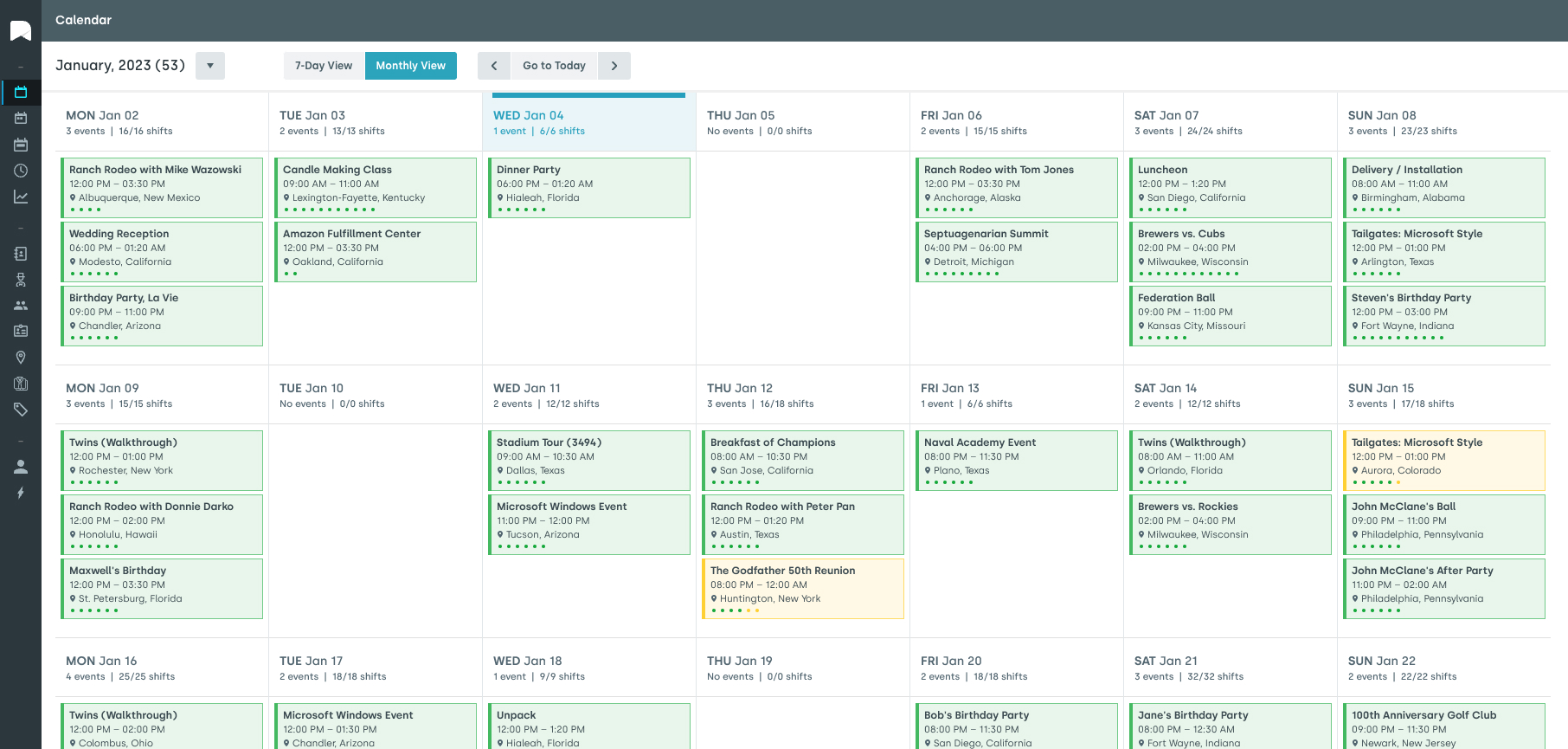
Side-by-Side Comparison
| Platform | Best For | Payroll | Scheduling/WFM | Global Payroll | Talent Management | Pricing |
|---|---|---|---|---|---|---|
| Nowsta | Hourly/contingent workforce | Integration | AI-powered (core strength) | No | No | Contact for pricing |
| Rippling | Unified HR + IT + Finance | Yes | Basic | Yes (50+ countries) | Yes | Custom pricing |
| ADP Workforce | Mid-size payroll-first | Yes (core strength) | Basic | Yes | Yes | Custom pricing |
| UKG Pro | Large enterprise HCM + WFM | Yes | Yes | Yes | Yes | Custom pricing |
| BambooHR | Small business core HR | Yes (US only) | No | No | Basic | Starts ~$13/employee/mo |
| Deel | Global hiring/EOR | Yes | No | Yes (150+ countries) | No | Starts $49/contractor/mo |
| Paylocity | Mid-size payroll + engagement | Yes | Basic | Limited | Yes | Custom pricing |
| SAP SuccessFactors | Large enterprise (SAP ecosystem) | Yes | Limited | Yes (100+ countries) | Yes (advanced) | Custom pricing |
| Gusto | Small business payroll | Yes (core strength) | No | No | No | From $40/mo + $6/employee |
Making the Switch From Workday
Leaving Workday is a significant decision, and the migration process matters as much as the platform you choose. Here’s how to approach it.
Migration Principles
- Start with your pain points, not the feature list. If you’re leaving Workday because of cost, don’t migrate to another enterprise-grade platform with the same pricing structure. If you’re leaving because scheduling is broken, prioritize a workforce management platform like Nowsta that solves that specific problem.
- Audit your current usage. Most organizations use 30 to 40% of Workday’s features. Document which hr modules, reports, and automated workflows you actually rely on. This becomes your minimum viable requirements list and prevents you from over-buying again.
- Plan for payroll data migration carefully. Employee data, tax records, benefits enrollment, and historical payroll data need to be transferred accurately. Work with your new provider’s implementation team to validate data integrity during parallel processing periods.
- Communicate the change to employees. If your team relies on Workday’s employee self-service portal for pay stubs, time-off requests, and benefits enrollment, they need to know what’s changing and when. Provide training on the new system before the cutover.
- Run parallel systems for one to two pay cycles. This catches discrepancies in payroll processing, tax filing, and time tracking before you decommission Workday entirely.
Build Your Ideal HR Stack With Nowsta at the Core
No single platform does everything perfectly. The best workday alternatives aren’t necessarily the ones that try to replace every Workday module. They’re the ones that solve your biggest pain points with less complexity, faster implementation, and transparent pricing.
Here’s what to take away:
- Workday’s cost, complexity, and steep learning curve make it a poor fit for many mid-sized companies and hourly-workforce operations
- The best alternative depends on your primary pain point: payroll, global compliance, talent management, or workforce management
- Enterprise HCMs consistently fail at real-time scheduling, labor forecasting, and hourly workforce management
- Purpose-built platforms outperform all-in-one suites for specific use cases
- Most organizations benefit from a focused HR stack rather than a single monolithic platform
- Nowsta fills the workforce management gap that Workday and other HCMs leave open for hourly and contingent teams
For operations managing hourly, shift-based, and contingent workers, Nowsta delivers what enterprise HCMs can’t: AI-powered scheduling, real-time attendance tracking, labor forecasting, and seamless payroll integration, all on one workforce management platform.
Looking for a platform that’s faster to implement and easier to use? Nowsta delivers enterprise-grade scheduling, payroll, and compliance without the complexity. Schedule a demo.
FAQs
What Is Better Than Workday?
The best alternative to Workday depends on your needs. For hourly and contingent workforce management, Nowsta outperforms Workday with AI-powered scheduling, real-time attendance tracking, and labor forecasting built for shift-based teams. For all-in-one HR and IT, Rippling offers a modern user interface with faster implementation. For payroll-first mid-sized companies, ADP Workforce Now delivers stronger payroll solutions with less complexity.
What Is the Free Alternative to Workday?
There is no completely free alternative that matches Workday’s full enterprise scope. However, Gusto offers affordable payroll software for small businesses with transparent pricing and no hidden fees, and BambooHR provides user-friendly core hr at a fraction of Workday’s cost. For specific workforce management needs, some platforms offer free trials that let hr teams evaluate before committing.
Why Is Workday Falling?
Workday faces growing criticism for its steep learning curve, high implementation costs, and lack of transparent pricing. The company laid off approximately 1,750 employees (8.5% of its workforce) as it restructured around AI investments. Many mid-sized companies and hr teams are finding that Workday competitors deliver faster time-to-value with less complexity, especially for managing employees in shift-based and hourly environments.
What Is the Best Payroll Software for Small Businesses?
Gusto is widely considered the best payroll software for small businesses. It offers full-service payroll processing with automated tax filing, unlimited payroll runs, contractor payments, and benefits administration. Paid plans start at $40/month plus $6/employee, with transparent pricing and no hidden fees. For small businesses that also need workforce management, pairing Gusto with Nowsta covers both payroll and scheduling.
What Are the Top 5 HCM Systems?
The top five HCM systems in 2026 are Workday (enterprise HR and finance), UKG Pro (enterprise HCM with strong workforce management), SAP SuccessFactors (global enterprise with SAP integration), ADP Workforce Now (payroll-first for mid-sized companies), and Rippling (modern integrated hr, IT, and payroll). For organizations with hourly workforces, adding Nowsta as a dedicated workforce management platform alongside any HCM fills the scheduling and labor forecasting gap.