Overtime pays 1.5 times regular wages, while double time pays twice the regular rate. Most employers know they owe overtime after 40 hours per week under federal law. But California requires double time after 12 hours in a single day or on the seventh consecutive workday. Miscalculate, and you’re facing wage claims, penalties, and legal fees.
Here’s what we’re covering:
- What overtime and double time mean, and how they differ in pay rate
- Federal FLSA requirements for overtime compensation
- State-specific rules, especially California’s unique double-time laws
- How to calculate both pay types for hourly and salaried employees
- When double time applies vs when it’s just voluntary
- Common compliance mistakes that trigger wage violations
Nowsta’s payroll system tracks hours worked and automatically applies the correct overtime rates based on where employees work. When state rules differ from federal requirements, the platform uses whichever standard pays workers more.
What Overtime and Double Time Mean
Overtime and double time are premium pay rates employers must pay when employees work beyond standard hours. Understanding the difference prevents costly compliance mistakes.
Overtime Defined
Overtime means paying non exempt employees at 1.5 times their regular rate of pay for hours worked beyond the standard threshold. This is commonly called “time and a half.”
Under federal laws, overtime compensation kicks in after 40 hours in a single workweek. If your regular hourly rate is $20, your overtime rate becomes $30 per hour ($20 × 1.5 = $30).
Overtime work exists to discourage employers from overworking staff and to fairly compensate eligible employees for the burden of extra hours.
Double Time Defined
Double time means paying employees at twice their regular rate of pay. If you normally earn $20 per hour, double time pays $40 per hour ($20 × 2 = $40).
Double time refers to a premium pay rate higher than standard overtime. While overtime wages are federally mandated, double time hours are typically only required under specific state laws or through collective bargaining agreements.
Key Differences at a Glance
| Factor | Overtime | Double Time |
|---|---|---|
| Pay Rate | 1.5x regular rate | 2x regular rate |
| Federal Requirement | Yes (FLSA) | No |
| State Requirements | Most states follow federal | California only (by law) |
| When It Applies | After 40 hours/week (federal) | After 12 hours/day (CA) or 7th consecutive workday |
| Voluntary | No, mandatory for nonexempt employees | Yes, except in California |
The fundamental difference: overtime is federally required at time and a half, while double time rate compensation only becomes mandatory under specific state laws or union contracts.
Federal FLSA Requirements for Overtime

The Fair Labor Standards Act (FLSA) establishes nationwide baseline overtime requirements. Every employer subject to federal jurisdiction must follow these rules.
The 40-Hour Workweek Threshold
Federal law mandates overtime at 1.5 times regular pay for hours worked over 40 in a workweek under the Fair Labor Standards Act.
Key points:
- A workweek is seven consecutive 24-hour periods (168 hours total)
- You can set different workweeks for different employee groups, but each must remain consistent
- The FLSA doesn’t limit daily hours worked, only weekly totals
- Overtime hours worked beyond 40 must be paid at the overtime premium rate
Example: An employee works 45 hours in one workweek at $16/hour regular pay.
- First 40 hours: 40 × $16 = $640
- Overtime hours: 5 × $24 (time and a half) = $120
- Total wages paid: $760
Who’s Covered vs Exempt
Not all employees receive overtime pay. The FLSA distinguishes between covered and exempt workers.
- Non exempt employees must be paid overtime. This includes most hourly workers and some salaried workers earning below salary thresholds.
- Exempt employees don’t qualify for overtime compensation if they meet both:
- Salary basis test: Paid at least $684/week ($35,568 annually) under federal rules
- Duties test: Perform executive, administrative, or professional work
Common exempt categories:
- Executive employees (managers with hiring/firing authority)
- Administrative employees (office/non-manual work supporting business operations)
- Professional employees (requiring advanced knowledge or creative work)
- Computer professionals (certain tech roles)
- Outside sales employees
Just paying someone a salary doesn’t automatically make them exempt. Both tests must be met.
What Counts Toward the 40-Hour Calculation
Computing overtime requires understanding which hours count as “hours worked.”
Hours that count:
- Active work time
- Required training sessions
- Travel time between job sites during work hours
- On-call time when movement is restricted
- Meal breaks under 20 minutes
Hours that don’t count:
- Meal breaks 30+ minutes where employee is completely relieved of duties
- Commute time from home to primary work location
- True on-call time where employee can use time freely
Employers sometimes miscalculate by excluding time that should count, creating unpaid overtime violations.
Federal Law Doesn’t Require Double Time
The FLSA establishes no double time requirement. Employers can pay double the regular rate voluntarily, but federal laws only mandate time and a half for overtime hours.
Double time remains optional under federal employment laws except where state laws or union contracts require it.
California’s Unique Double Time Laws

California is the only state with mandatory double time requirements written into law. California’s wage rules go far beyond federal standards.
Daily Overtime Triggers
California requires overtime in more situations than most states, including after 8 hours in a single workday.
California labor code overtime rules:
- After 8 hours in one day: Pay time and a half for hours 9-12
- After 12 hours in one day: Pay double time for all hours beyond 12
- After 40 hours in a workweek: Pay time and a half (same as federal)
Example: Employee works a 14-hour shift at $20/hour.
- Hours 1-8: 8 × $20 = $160 (regular rate)
- Hours 9-12: 4 × $30 (overtime rate) = $120
- Hours 13-14: 2 × $40 (double time rate) = $80
- Total: $360
Both overtime and double time can apply in the same workday under California law.
Seventh Consecutive Day Rules
California imposes special rules when employees work seven days in a row within a single workweek.
On the seventh consecutive day:
- First 8 hours: Paid at overtime rate (1.5x)
- Beyond 8 hours: Paid at double time rate (2x)
This applies even if the employee hasn’t exceeded 40 hours earlier in the week.
Example: Employee works 6 days (6 hours each) then an 10-hour shift on day seven.
- Days 1-6: 36 hours at regular rate
- Day 7, hours 1-8: 8 hours at time and a half
- Day 7, hours 9-10: 2 hours at double time
Total weekly hours = 46, but pay calculation uses California’s daily and consecutive day rules, not just the 40-hour threshold.
Who’s Covered in California
California’s overtime and double time rules apply to non exempt employees. The state uses similar exemption tests as federal law but with higher salary thresholds in some cases.
California exemptions require:
- Meeting duties tests (executive, administrative, professional)
- Earning at least twice the state minimum wage for full-time work
- Exercising independent judgment and discretion
Misclassification remains a major compliance risk. Many employers incorrectly classify workers as exempt to avoid paying overtime wages.
Alternative Workweek Schedules Exception
California allows employers and employees to agree on alternative workweek schedules that avoid daily overtime.
How it works:
- Employees vote to approve schedule (2/3 majority required)
- Can work up to 10 hours/day without daily overtime
- Overtime still applies beyond agreed daily hours or 40 hours/week
This benefits employers wanting four 10-hour shifts without triggering daily overtime. But the process requires formal employee voting and Department of Labor approval.
Calculating Overtime and Double Time
Calculating overtime pay correctly prevents wage violations and builds trust with your workforce. Here’s how to do it for different employee types.
For Hourly Employees
Hourly workers have straightforward calculations since their regular hourly wage is already established.
- Step 1: Identify the regular rate This is the employee’s standard hourly pay.
- Step 2: Calculate overtime rate Multiply regular rate by 1.5 for time and a half.
- Step 3: Calculate double time rate Multiply regular rate by 2.
Example: $18/hour regular pay
- Overtime rate: $18 × 1.5 = $27/hour
- Double time rate: $18 × 2 = $36/hour
For Salaried Workers (Non-Exempt)
Salaried employees who don’t meet exemption requirements must still receive overtime pay. Computing overtime for them requires converting salary to an hourly rate.
Step 1: Determine the regular rate
Divide weekly salary by hours the salary is meant to cover (typically 40).
Example: Employee earns $800/week salary covering 40 hours.
- Regular hourly rate: $800 ÷ 40 = $20/hour
Step 2: Calculate overtime premium
Use the calculated hourly rate to determine time and a half and double time.
- Overtime: $20 × 1.5 = $30/hour
- Double time: $20 × 2 = $40/hour
Step 3: Track actual hours worked
Example continued: Employee works 48 hours in the workweek.
Pay regular salary plus overtime premium for hours beyond 40 (or 8 in California).
- Salary covers first 40 hours: $800
- 8 overtime hours: 8 × $30 = $240
- Total pay: $1,040
Including Bonuses and Commissions
The regular rate of pay isn’t always just base wages. Certain bonuses and commissions must be included when calculating overtime.
Must include:
- Non-discretionary bonuses (guaranteed production bonuses, attendance bonuses)
- Commissions
- Shift differentials for non-standard hours
Can exclude:
- Discretionary bonuses (employer decides amount and whether to pay)
- Gifts for special occasions
- Reimbursements for expenses
- Premium pay for weekend/holiday work (if 1.5x or more)
Calculation when bonuses apply:
- Add all compensation for the pay period (wages + bonuses + commissions)
- Divide by total hours worked to get the true regular rate
- Calculate overtime premium using this adjusted regular rate
This gets complex, but it’s required by both federal and state laws to prevent employers from lowering overtime costs through bonus manipulation.
California-Specific Calculations
California’s rules require tracking both daily and weekly hours.
Daily overtime example: Employee works Monday-Thursday (9 hours each), Friday (10 hours).
- Monday-Thursday: Each day has 8 regular + 1 overtime = 32 regular hours + 4 overtime hours
- Friday: 8 regular + 2 overtime = 8 regular hours + 2 overtime hours
- Weekly total: 40 regular hours + 6 overtime hours
Notice that even though total hours (46) would trigger only 6 overtime hours federally, California’s daily rules already captured all overtime through the 8-hour daily threshold.
Double time example: Employee works a 13-hour shift.
- Hours 1-8: Regular rate
- Hours 9-12: Time and a half
- Hour 13: Double time rate
Track every hour carefully in California because more than eight hours in a single workday creates tiered pay requirements.
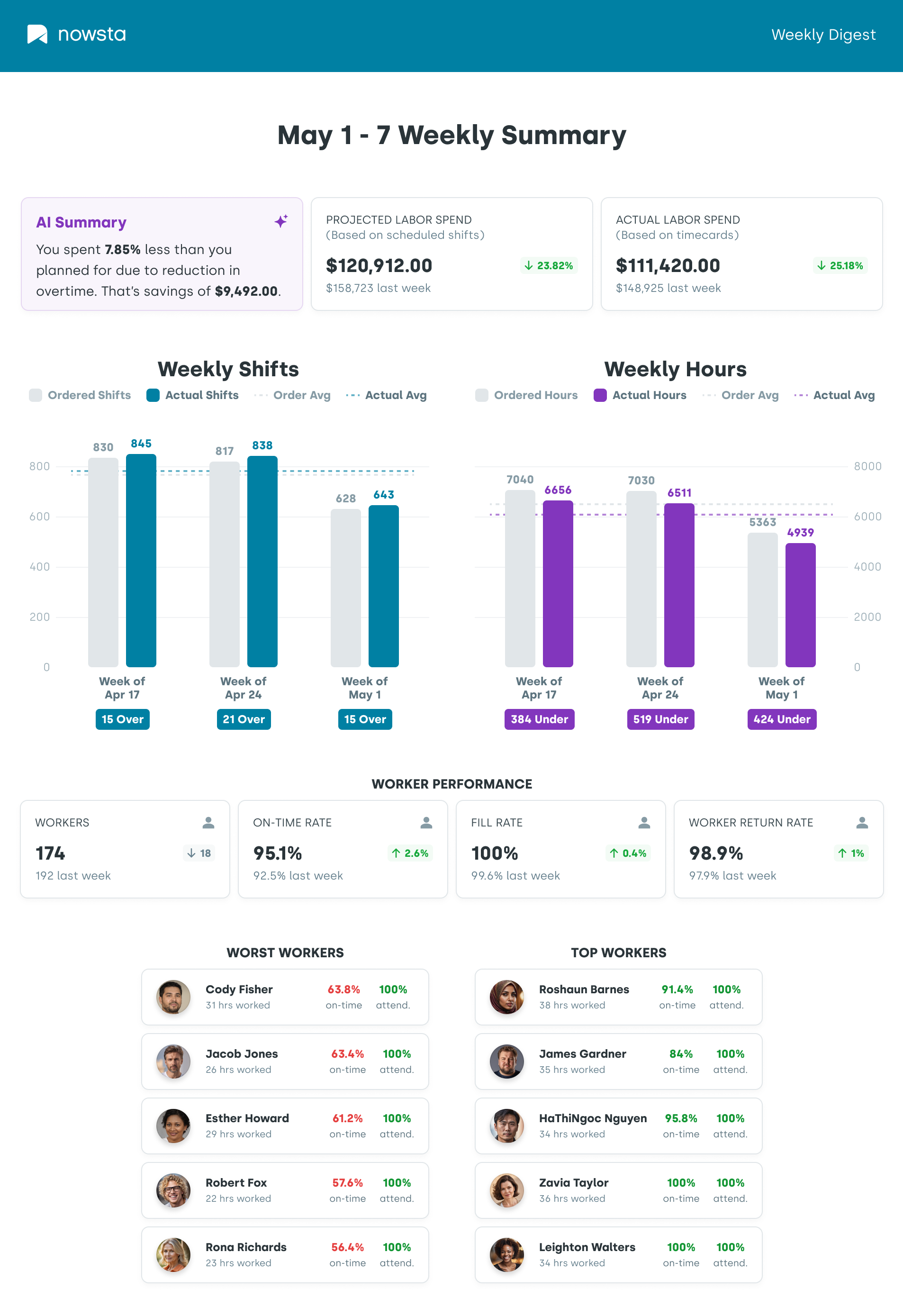
Nowsta automatically calculates overtime and double time based on federal and California labor code rules, tracking daily and weekly hours to apply the correct pay rates without manual math.
When Double Time Is Required vs Voluntary
Understanding when double time rate pay is mandatory versus optional prevents unnecessary labor costs while maintaining compliance.
Mandatory Double Time Scenarios
California law requirements:
Non-exempt employees earn double time pay when working more than 12 hours in a single workday or more than 8 hours on the seventh consecutive day in a workweek.
These aren’t optional. California employers must pay double time in these situations:
- After 12 hours in one day
- Hour 13 onward = double time
- Applies regardless of weekly total
- Seventh consecutive workday (hours 9+)
- First 8 hours on day 7 = time and a half
- Beyond 8 hours on day 7 = double time
Union contracts and collective bargaining agreements:
Unionized workplaces often negotiate double time provisions covering:
- Weekend work
- Holiday shifts
- Overnight hours
- Certain hazardous duty assignments
If your collective bargaining agreement specifies double time for certain conditions, you must honor it regardless of state law requirements.
Voluntary Double Time Situations
Outside California and union contracts, double time is typically voluntary.
Common voluntary scenarios:
- Holiday premium pay. Many employers offer double time for working Thanksgiving, Christmas, or New Year’s Day to incentivize coverage. Federal laws don’t require this, but it’s a common employer’s policy.
- Emergency situations. Some employers pay double time for last-minute call-ins or emergency shifts to ensure adequate staffing.
- Weekend differential. Offering double time for Saturday/Sunday shifts can help fill scheduling gaps in industries with weekend operations.
- Overnight shifts. Double time for overnight work (11 PM – 7 AM) helps attract workers to less desirable hours.
These are business decisions, not legal requirements. You can offer them to remain competitive or eliminate them to control costs.
Federal Contractors and Government Work
Federal contractors sometimes face double time requirements under specific contracts, even though the FLSA doesn’t mandate it generally.
- Davis-Bacon Act (construction projects): Requires paying prevailing wages, which may include double time provisions depending on local wage determinations.
- Service Contract Act (federal service contracts): Similar prevailing wage requirements that sometimes specify double time for specific conditions.
Check your contract terms. Federal government work often includes pay requirements exceeding standard federal laws.
What “Voluntary” Means Legally
If you establish a pattern of paying double time voluntarily, it can become an implied employment term.
- Risk: Consistently paying double time for Sundays creates employee expectation. Suddenly stopping without clear communication could trigger morale issues or claims of changed employment terms.
- Best practice: Document voluntary premium pay in written policies stating it’s discretionary and subject to change. This preserves flexibility while being transparent.
Common Compliance Mistakes That Trigger Violations

Even well-intentioned employers make overtime and double time errors that create legal exposure. Here are the costliest mistakes.
Misclassifying Employees as Exempt
Misclassification remains one of the most common reasons employees miss out on overtime and double time pay.
- The mistake: Assuming anyone paid a salary is exempt from overtime.
- Reality: Exempt status requires meeting both salary basis and duties tests. Paying someone $40,000/year doesn’t make them exempt if their job doesn’t involve executive, administrative, or professional duties.
- Example violation: Labeling a restaurant shift supervisor as “manager” and paying salary, but they spend 80% of time doing the same work as hourly staff. They’re likely non-exempt and owed overtime.
How to avoid:
- Review each position against federal and state exemption tests
- Don’t rely on job titles alone
- When in doubt, classify as non-exempt
The cost of misclassification includes back pay for all unpaid overtime, penalties, and legal fees. It’s cheaper to pay overtime than fight a wage claim.
Ignoring Daily Overtime in California
- The mistake: Applying only the 40-hour weekly threshold in states with daily overtime – requirements.
- Reality: California requires overtime after 8 hours in a single workday, regardless of weekly totals.
- Example violation: Employee works four 10-hour days (40 hours total). Employer pays straight time because weekly hours don’t exceed 40.
Correct payment under California law:
- 32 hours at regular rate (8 hours × 4 days)
- 8 hours at overtime rate (2 hours × 4 days)
How to avoid:
- Track daily hours separately in California
- Configure payroll systems to flag daily overtime triggers
- Train managers on state-specific rules
Forgetting the Seventh Consecutive Day Rule
- The mistake: Not tracking whether employees worked seven consecutive days within the same workweek.
- Reality: California requires overtime on the first 8 hours and double time after 8 hours on the seventh consecutive day, even if weekly hours are under 40.
- Example violation: Employee works Sunday-Saturday, 6 hours each day (42 hours total). Employer pays 40 regular + 2 overtime.
Correct payment under California’s wage laws:
- Sunday-Friday: 36 hours regular
- Saturday (day 7): 6 hours at time and a half
- Total: 36 regular + 8 overtime (6 from Saturday + 2 from exceeding 40)
Special rules apply here that many employers miss.
Averaging Hours Across Multiple Weeks
- The mistake: Averaging hours across two pay periods to avoid overtime.
- Example violation: Employee works 50 hours week one, 30 hours week two. Employer averages to 40 hours/week and pays straight time for all hours.
- Reality: Overtime rules apply within a single workweek, not across multiple weeks. Each workweek stands alone.
Correct payment:
- Week 1: 40 regular + 10 overtime
- Week 2: 30 regular + 0 overtime
Federal laws prohibit averaging unless you’re using a fluctuating workweek method with proper agreements in place (rare and complex).
Excluding Bonuses from Regular Rate Calculations
- The mistake: Calculating overtime using only base hourly pay when employees also earn non-discretionary bonuses or commissions.
- Reality: The regular rate must include certain bonuses and commissions, which increases the overtime rate owed.
- Example violation: Employee earns $15/hour plus $200 production bonus for the week, working 50 hours total.
Wrong calculation:
- Overtime rate: $15 × 1.5 = $22.50
- Pay: (40 × $15) + (10 × $22.50) + $200 = $1,025
Correct calculation:
- Total compensation: (50 × $15) + $200 = $950
- Regular rate: $950 ÷ 50 hours = $19/hour
- Overtime premium: $19 × 0.5 = $9.50/hour extra for OT hours
- Correct pay: $950 + (10 × $9.50) = $1,045
The employee is owed an extra $20 in this example. Multiply across hundreds of employees over months, and underpayment adds up fast.
Not Paying for “Off the Clock” Work
- The mistake: Assuming employees only need payment for scheduled hours.
- Reality: All hours worked must be paid, even unauthorized overtime.
- Example violation: Employee clocks out at 5 PM but continues answering work emails until 6 PM. Employer doesn’t count that hour.
- Correct approach: In California, if you work overtime but were not told to do so, or if the work was not approved in advance, you are still entitled to receive overtime pay.
Even if your employer’s policy prohibits unauthorized extra hours, you must still pay for them. You can discipline the employee for violating policy, but you can’t refuse payment.
Failing to Track Time for Salaried Non-Exempt Workers
- The mistake: Not tracking hours for salaried employees because they receive a set weekly amount.
- Reality: Salaried non-exempt employees must still track hours to calculate overtime pay owed beyond their salary.
If you pay someone a $600/week salary for 40 hours but they work 48 hours, you owe an additional overtime premium for those 8 extra hours.
Without time tracking, you can’t prove compliance or calculate correct pay.
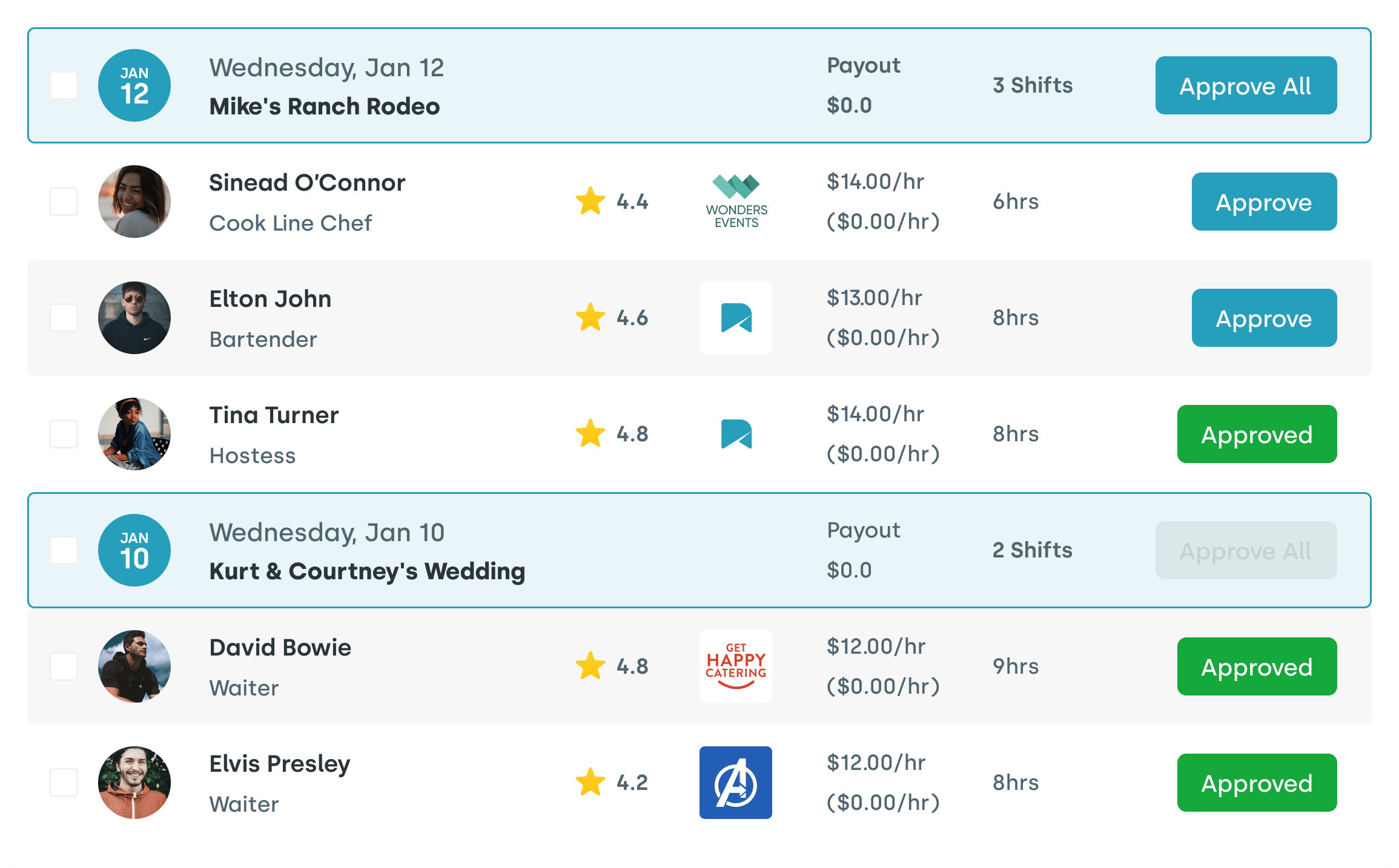
Nowsta’s time tracking system monitors daily and weekly hours automatically, flags potential violations before payroll runs, and maintains audit trails proving compliance with federal and state employment laws.
Get Overtime and Double Time Right with Nowsta
Overtime pays 1.5X regular wages after 40 weekly hours under federal law, while double time pays 2x and is only mandatory in California after 12 daily hours or on seventh consecutive workdays. Miscalculating either creates wage violations, penalties, and employee distrust.
Key takeaways:
- Overtime (time and a half) is federally required after 40 hours per week; double time (2x pay) is typically voluntary except in California
- California requires overtime after 8 hours daily and double time after 12 hours daily or 8+ hours on the seventh consecutive day
- Both hourly and salaried non-exempt employees must receive overtime pay based on their regular rate, including certain bonuses
- Common violations include misclassifying exempt employees, ignoring daily overtime triggers, averaging hours across weeks, and excluding bonuses from overtime calculations
- Employers must pay for all hours worked, even unauthorized overtime, though they can discipline policy violations separately
- Proper time tracking, payroll configuration, and documentation prevent costly compliance mistakes
Nowsta automatically tracks employee hours, applies correct overtime and double time rates based on federal and state rules, and flags potential violations before payroll processes. When employees work across multiple locations with different labor laws, the platform ensures compliance everywhere without manual calculations.
Losing track of pay rules across shifts and locations? Nowsta automates calculations and syncs everything directly to payroll. Schedule a demo.
FAQs
Are overtime and double time the same?
No. Overtime vs double time differs in pay rate: overtime pays 1.5 times the employee’s regular rate (time and a half), while double time pays twice the normal rate. Overtime is federally mandated after 40 hours per week, but double time is only required under specific state laws like California or through union agreements. Most employees receive overtime, not double time.
What is double time for $17 an hour?
Double time for $17/hour equals $34/hour ($17 × 2 = $34). This is extra pay at twice your normal rate. By comparison, one half times the regular rate (overtime) would be $25.50/hour ($17 × 1.5). Double time typically applies only in California after 12 hours in a single workday or certain other specific conditions.
How does double time work at a job?
Double time means you earn twice your employee’s regular rate for specific hours worked. At the same employer, your regular hours pay the normal rate, overtime hours pay 1.5x, and double time hours pay 2x. California law mandates double time after 12 daily hours, but most states only require overtime. Employee scheduling systems must track which hours qualify for each rate.
What does being paid double time mean?
Being paid double time means receiving compensation at twice your regular hourly wage for certain employee hours worked. For example, if your annual salary converts to $20/hour, double time pays $40/hour. This extra pay compensates workers for exceptionally long shifts or consecutive workdays. Only certain employees in specific situations qualify, primarily in California or under union contracts.
What are the rules for double time in California?
California requires double time when non-exempt employees work more than 12 hours in a single workday or over 8 hours on the seventh consecutive day in a workweek. Employees must receive one half times their rate for hours 9-12, then double time for hour 13 onward. These rules apply regardless of weekly totals. Violations can be reported to the Labor Commissioner for investigation and potential back pay recovery.