A sold-out NFL game needs 2,000+ staff coordinated across ticketing, concessions, security, and janitorial in under four hours. FIFA 2026 will require 823,000 jobs filled across 16 cities and three countries. One mis-staffed section creates bottlenecks that ripple through the entire venue. Industry average no-show rates hit 15%, forcing venues to overbook every shift.
Here’s what we’re covering:
- Why stadium staffing is uniquely complex compared to other hospitality operations
- Pre-event planning systems that prevent day-of chaos
- Technology platforms that coordinate thousands of workers in real-time
- How to handle no-shows, last-minute changes, and surge demand
- Compliance management across temporary, seasonal, and contracted staff
- Real-world case studies from the Super Bowl, FIFA, and major concert venues
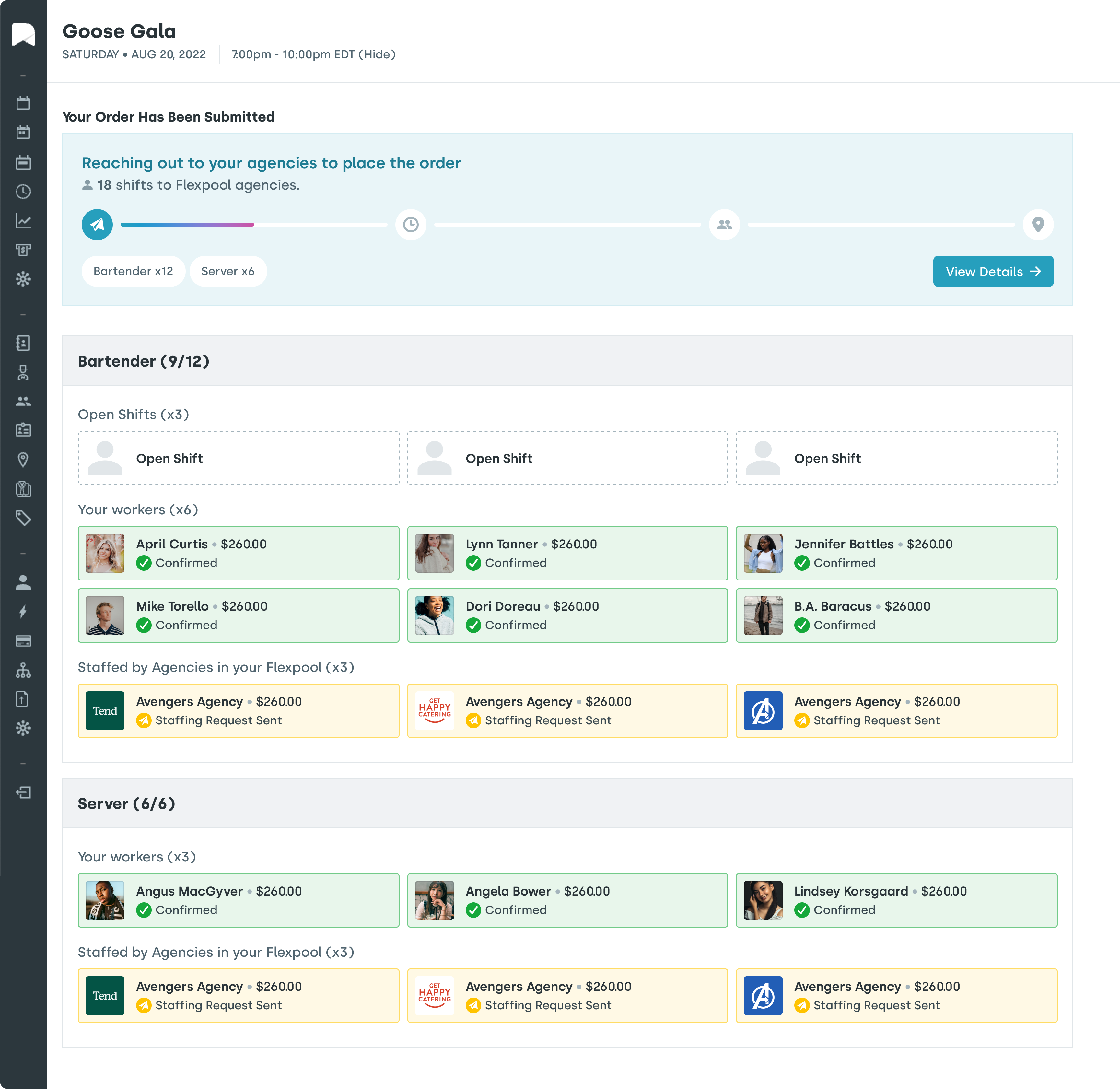
Nowsta’s workforce orchestration platform helps venue operators manage thousands of event staff across multiple locations. The system automatically handles credentialing, compliance tracking, and real-time shift coverage when workers don’t show.
Why Stadium Staffing Is Uniquely Complex
Stadium staffing creates challenges that don’t exist in other industries. A restaurant might need 40 staff members for a busy Friday. A stadium needs 2,000 for four hours, then zero for three days.
The Scale Problem
Volume fluctuates wildly. College football stadiums average 41,867 attendees per game. Super Bowl venues handle 70,000+ passionate fans. Each event attendees require staffing across dozens of operational zones simultaneously.
Unlike hotels or restaurants, where staffing levels stay relatively consistent, stadium operations swing from skeleton crews to massive workforces overnight. You can’t maintain 2,000 full-time employees for 10 home games per year.
Multiple Specialized Roles Running Concurrently
A successful event requires filling critical roles across completely different skill sets at the same time:
- Ticketing and access control: First point of contact, must process thousands quickly
- Concessions: Food handling certifications, cash management, speed under pressure
- Security and crowd management: Conflict de-escalation, safety protocols, credentialing
- Ushers and guest services: Venue knowledge, customer service, ADA accommodations
- Janitorial and facilities: High-traffic cleaning, restroom maintenance, waste management
- Premium suites staffing: Elevated service standards, hospitality skills
- Parking management: Traffic flow, payment processing, crowd control
Each department has unique challenges and performance metrics. You can’t just hire temporary staff and plug them anywhere.
Compressed Timeline, Zero Margin for Error
Traditional hospitality operations have a recovery time. If a restaurant is understaffed on Tuesday, they adjust for Wednesday. Stadium operations don’t get do-overs.
Gates open in 90 minutes. That’s your window. If 200 workers don’t show up, there’s no time to recruit replacements. Long lines form. Concession stands close. Fan experience suffers. Lost revenue adds up fast.
The hour before the event is critical, with venues scrambling to confirm all staff are en route or in position. By the time you realize someone’s missing, guests are already arriving.
Workforce Is Predominantly Temporary
Stadiums demand large workforces for operations, including ticketing, concessions, event management, food and beverage, and janitorial. Most of these workers are temporary labor, not permanent employees.
Temporary workers create different staffing challenges:
- Less venue familiarity than permanent staff
- Variable availability week to week
- Higher no-show rates
- Need more role-specific training
- Compliance documentation expires
- Less investment in the employer relationship
You’re coordinating hundreds of people who may work one event per month and have other jobs filling their schedule.
Regulatory and Compliance Complexity
Stadium staffing involves multiple layers of compliance that other industries don’t face:
- Background checks for anyone working near minors or handling cash.
- Alcohol service certifications for bar and concession staff.
- Food handler permits in most jurisdictions.
- Security credentials for access control positions.
- ADA training for guest services roles.
Each certification expires on different schedules. Track it manually, and you’ll inevitably schedule someone whose certification lapsed two weeks ago.
Pre-Event Planning That Prevents Chaos
The biggest staffing challenges get solved months before game day, not hours before gates open. Here’s how experienced professionals plan for large-scale events without losing their minds.
Start With Historical Data
Past attendance drives staffing needs. If last year’s opening game drew 52,000 fans, you’ll need similar staffing levels unless something fundamental changed.
Advanced scheduling software pulls historical data on:
- Attendance by event type (regular season vs playoffs, weekday vs weekend)
- Concession sales volume per 1,000 attendees
- Peak traffic patterns (gates open, halftime, post-event exit)
- Weather impact on outdoor venues
- Local factors (team performance, rival matchups, promotions)
This creates baseline staffing levels for each department before you make a single hire.
Build Staffing Ratios for Each Zone
Event organizers who succeed at large workforce management don’t guess. They use proven ratios:
| Area | Staffing Ratio | Notes |
|---|---|---|
| Ticketing/Gates | 1 per 500 guests | Scale up 30 minutes before gates open |
| Concessions | 1 per 75-100 guests | Varies by menu complexity |
| Security | 1 per 250 attendees | Higher for high-risk events |
| Ushers | 1 per 200-300 seats | Depends on venue layout |
| Restrooms/Janitorial | 1 per 1,000 guests | Increase during peak periods |
| Premium Suites | 1 per 15-20 guests | Higher service standard |
These ratios give you a starting point. Adjust based on venue specifics, event type, and past performance metrics.
Create Detailed Position Descriptions
Vague job postings create confusion. “Event staff needed” attracts everyone and qualifies no one.
Be specific about:
- Exact responsibilities (cash handling, crowd control, food prep)
- Required certifications (food handler card, alcohol service permit)
- Physical demands (standing 4+ hours, lifting 30 lbs, outdoor weather exposure)
- Shift timing (arrive 90 minutes before gates, stay 60 minutes post-event)
- Uniform requirements
- Pay rate and payment schedule
Clear communication eliminates workers showing up unprepared or declining shifts at the last minute when they realize what’s required.
Recruit Year-Round, Not Week-Of
Recruiting numbers from job fairs provide an early warning if the temporary worker supply won’t meet demand. Don’t wait until two weeks before opening day to start hiring temporary staff.
Build your talent pool continuously:
- Maintain a database of qualified professionals who’ve worked past events
- Partner with staffing agencies specializing in event staffing
- Recruit from colleges, retirees, and workers seeking flexible schedules
- Offer priority scheduling to reliable staff from previous events
- Run ongoing recruitment even during the off-season
Top venues maintain relationships with 3-5x more workers than they need per event, knowing only a fraction will be available for any given shift.
Schedule in Waves, Not All at Once
Successful partners post blocks of shifts weeks in advance, then cancel unneeded ones closer to event dates. This “overbook and trim” strategy prevents understaffing while building in flexibility.
- Wave 1 (6-8 weeks out): Post 120% of anticipated staffing needs
- Wave 2 (3-4 weeks out): Fill remaining gaps, cancel excess shifts
- Wave 3 (1 week out): Final adjustments based on confirmed attendance and weather
- Wave 4 (Day-of): Emergency replacements for no-shows
This staged approach gives you buffer capacity without paying for unnecessary labor.
Conduct Pre-Event Staff Training
Having temporary workers watch instructional videos or complete training courses before arriving leaves them better prepared. Don’t expect first-time workers to show up and immediately perform in high-pressure environments.
Remote training options:
- Video walkthroughs of venue layout and key locations
- Safety protocols and emergency procedures
- Customer service standards specific to your operation
- Point-of-sale or systems training for concessions/ticketing
- Quiz to confirm comprehension
Mobile apps make this easy. Workers complete training on their phones, and you verify completion before scheduling them.
On-site orientation still matters for large events. Brief workers 30-60 minutes before shifts start:
- Reinforce key procedures
- Answer questions
- Distribute uniforms or credentials
- Assign specific positions
- Introduce supervisors
This small task prevents confusion during critical opening hours.
Nowsta automates pre-event planning by maintaining your qualified worker pool, tracking certifications, and scheduling in waves. When historical data says you need 1,800 workers, the platform fills those shifts automatically based on availability and qualifications.
Technology Platforms Coordinating Thousands
Manual scheduling collapses at stadium scale. Spreadsheets can’t track 2,000 workers across 50 positions with real-time updates. Here’s how smart stadium technology keeps everyone on the same page.
Centralized Workforce Management Systems
Modern platforms consolidate everything event management needs:
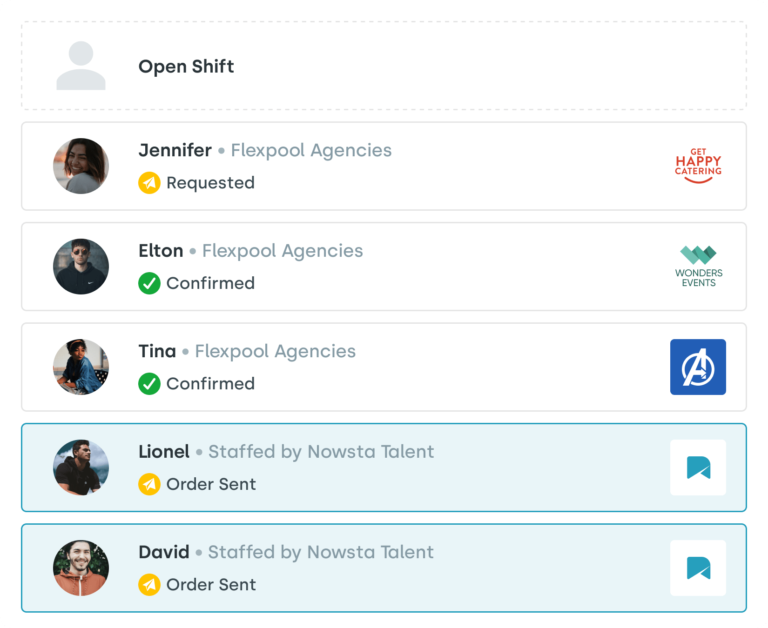
- Worker databases store contact info, certifications, work history, performance ratings, and availability for thousands of temporary workers in one searchable system.
- Automated scheduling matches staff to shifts based on qualifications, location, past performance, and preferences. The system knows who’s alcohol-certified, who worked security last month, and who lives 10 minutes from the venue.
- Credential tracking monitors expiration dates for certifications, background checks, and required training. Push notifications alert workers when renewals are due.
- Time and attendance uses geofencing and mobile check-in to verify workers arrived on-site. Automated reminders reduce arriving late and no-shows.
- Payroll integration calculates hours worked, applies correct pay rates by position, and processes payments automatically. No manual time card entry across hundreds of workers.
Platforms like Nowsta handle all of this in one interface, giving event organizers visibility into their entire large workforce simultaneously.
Mobile Apps for Real-Time Communication
Tools like Connecteam provide scheduling, task management, and workplace communication, allowing team members to receive real-time updates and report concerns.
Workers use mobile apps to:
- View upcoming shifts and venue directions
- Claim open shifts when they have availability
- Request schedule changes or time off
- Check in when arriving on-site
- Access training materials and safety protocols
- Report issues or ask questions during shifts
- Receive push notifications about last-minute changes
Managers use the same apps to:
- Send mass communications to entire departments
- Post emergency shift openings
- Approve or deny shift swap requests
- Track who’s checked in vs who’s missing
- Dispatch workers to understaffed areas in real-time
- Collect feedback after events
This creates real time communication without relying on phone calls or group texts that get lost in chaos.
Live Dashboards for Event Day Operations
During events, venue GMs require comprehensive live views of proceedings, including finances, attendance, supplier status, and worker whereabouts.
Operations dashboards display:
- Staffing levels by department (planned vs actual)
- Heat maps showing worker distribution across the venue
- No-show counts and fill rates
- Real-time alerts for understaffed sections
- Labor cost tracking vs budget
- Performance metrics (transaction speed, customer complaints, safety incidents)
Managers spot problems instantly. If concession stand 14 only has 2 workers instead of 5, the dashboard flags it in red. You can redeploy staff from overstaffed areas or call in backups before long lines form.
Automated Communication Reduces Manual Work
Pre-event reminders go out automatically:
- 7 days before: “Your shift at MetLife Stadium is confirmed.”
- 24 hours before: “Reminder: Gates staff shift tomorrow at 4 PM. Parking in Lot C.”
- 2 hours before: “Your shift starts soon. Don’t forget your ID badge.”
Workers who don’t check in 30 minutes before their shift trigger automatic alerts to supervisors, who can activate backup staff.
Post-event surveys collect feedback automatically, creating performance data for future staffing decisions.
Integration With Other Stadium Systems
Smart stadium technology connects workforce platforms to other operational systems:
- Point-of-sale integration shows which concession stands are moving product quickly, indicating if staff levels match demand.
- Access control systems track which credentialed workers entered which zones, creating audit trails for security and compliance.
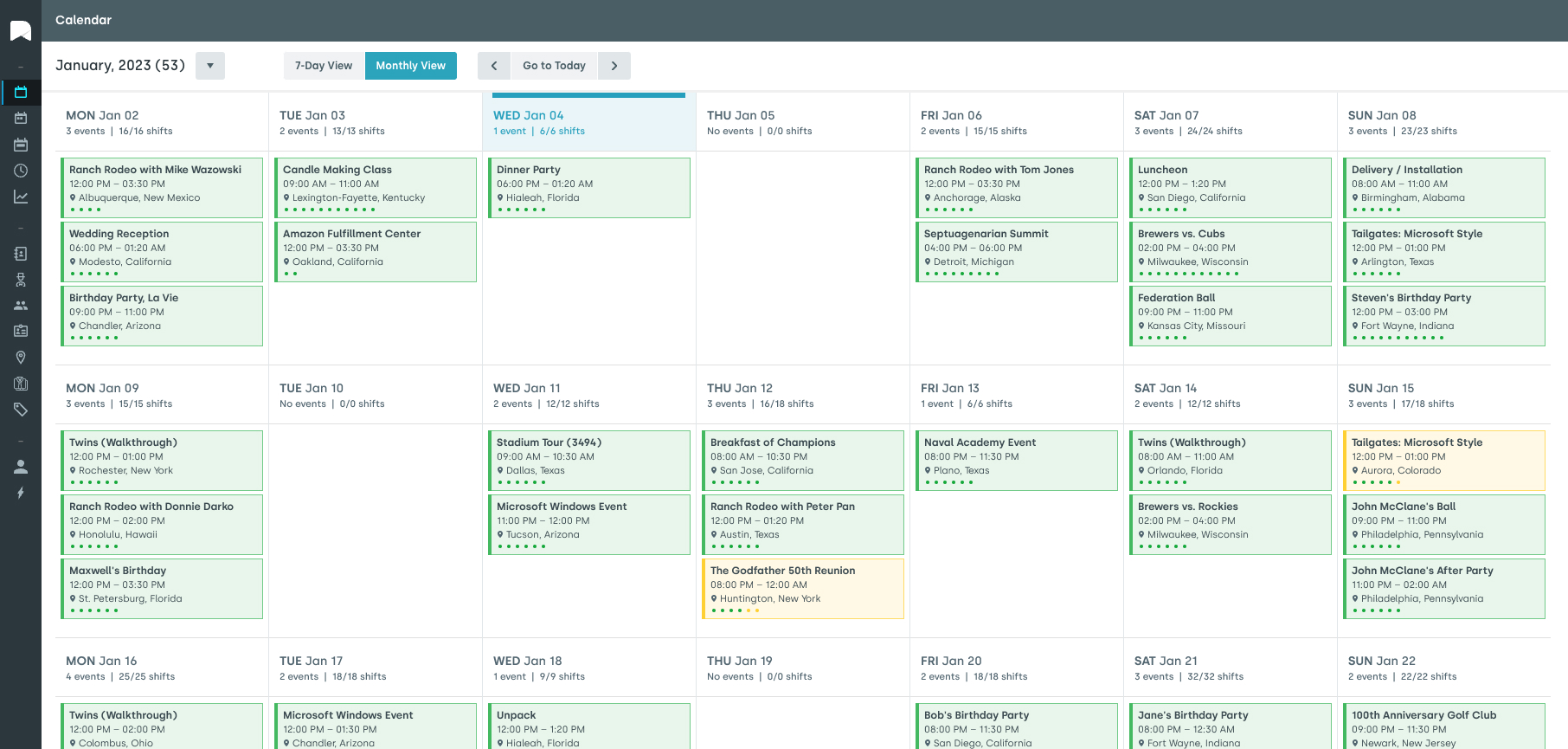
- Scheduling software syncs with event calendars, automatically creating shift templates when new games or concerts get added to the schedule.
This removes manual data entry and keeps all systems aligned.
Handling No-Shows, Changes, and Surge Demand

Even perfect planning can’t prevent every problem. Here’s how venues solve problems in real-time when the unexpected happens.
The 15% No-Show Reality
Industry average no-show rates hit 15%, forcing organizations to overbook 15% more workers per job. If you need 1,000 workers, schedule 1,150 knowing some won’t show.
Why workers no-show:
- Forgot about the shift
- Took a higher-paying gig elsewhere
- Personal emergency or illness
- Transportation issues
- Schedule conflicts from their other job
You can reduce no-shows, but you can’t eliminate them entirely with temporary labor.
Tiered Backup Systems
Smart venues build layers of backup coverage:
- Tier 1: Overscheduling: Book 10-15% extra staff, then release them if everyone shows. Most workers accept this trade-off for guaranteed shifts.
- Tier 2: On-Call Pool: Maintain a roster of qualified professionals who agree to be available on short notice in exchange for premium pay (time-and-a-half or guaranteed minimum hours even if called off).
- Tier 3: Staffing Partner Agreements: Contract with agencies who guarantee same-day fill rates for critical roles. You pay a premium, but they provide emergency coverage.
- Tier 4: Cross-Trained Permanent Staff: Your full-time operations team can fill gaps in a pinch. Not scalable for massive shortfalls, but handles 5-10 missing workers.
Real-Time Shift Marketplace
Modern platforms create internal marketplaces where workers claim open shifts:
How it works:
- Manager posts emergency opening (Concession Stand 7, starting in 2 hours)
- Push notifications go to all qualified workers in the area
- First person to accept gets the shift
- System confirms and updates schedules instantly
This fills gaps in minutes without phone calls or texts to dozens of people.
Dynamic Redeployment During Events
Real-time orchestration handles staff reassignment based on changing conditions like venue load spikes or crowd flow models.
- Mid-event scenario: Third-quarter concession rush hits stands near home team sections harder than visitor sections. Your dashboard shows 20-minute wait times in Stands A-D, while Stands E-F have no lines.
- Dynamic response: Redeploy 5 workers from slow sections to overwhelmed areas. Send push notifications with new assignments. Workers check in at new locations via mobile app, confirming they made the move.
This flexibility prevents the fan experience from deteriorating when demand shifts unexpectedly.
Weather and Last-Minute Event Changes
Outdoor venues face unique challenges. Rain delays, extreme heat, or surprise schedule changes throw off carefully planned staffing.
Proactive strategies:
- Monitor weather forecasts 48-72 hours before events
- Adjust staffing levels based on likely attendance impact
- Brief workers on contingency plans (delay procedures, early closure protocols)
- Have communication trees ready to notify staff of cancellations
Mobile apps make this manageable. One message reaches your entire large workforce instantly instead of playing phone tag with hundreds of people.
Managing Employee Burnout in Busy Season
For sports stadiums, temporary labor supply tends to tail off as seasons wear on, especially for outdoor games during winter. Workers get fatigued, find other opportunities, or stop responding.
Prevent burnout:
- Limit consecutive shifts for individual workers
- Rotate difficult positions (parking in freezing weather, high-stress security roles)
- Offer incentive bonuses for completing the entire season
- Recognize top performers publicly
- Create clear communication channels for workers to voice concerns
Happy workers come back. Burned-out workers ghost you mid-season.
Nowsta’s real-time visibility shows exactly who’s checked in, who’s running late, and who didn’t show. Managers access backup pools instantly and redeploy staff with a few clicks, preventing chaos before it starts.
Compliance Across Temporary and Seasonal Staff

Stadium operations create compliance nightmares. Hundreds of temporary workers cycling through, each needing different certifications, creates risk if not managed systematically.
Certification and Credential Tracking
Different roles require different documentation:
| Position | Required Credentials | Renewal Cycle |
|---|---|---|
| Concessions | Food handler card, cash handling clearance | 2-3 years (varies by state) |
| Alcohol Sales | Server permit, age verification training | 2-5 years |
| Security | Background check, conflict management training | Annual |
| Access Control | Venue-specific credentialing | Per season |
| First Aid | CPR/AED certification | 2 years |
| Parking | Driver’s license verification | Annual check |
Manual tracking fails at scale. You’ll inevitably schedule expired workers.
Automated compliance systems:
- Store credential documents digitally
- Flag expiring certifications 30-60 days before lapse
- Auto-remove workers from eligible shift lists when creds expire
- Send renewal reminders to workers via push notifications
- Verify updates before re-enabling scheduling
This prevents compliance violations that could shut down operations or create liability.
Background Check Management
Large-scale national events require more scrutiny on background checks, increased security, and pressure to ensure staff availability.
Key requirements:
- Criminal history checks (varies by venue and role)
- Sex offender registry verification (required for youth-present events)
- Motor vehicle records (parking and shuttle drivers)
- Reference verification
Background checks expire annually in most cases. Your system needs to track completion dates and trigger renewals automatically.
Labor Law Compliance for Multi-State Events
Large events like FIFA 2026 or touring concerts create multi-jurisdiction complexity. A security coordinator in Seattle follows US labor laws while Vancouver counterparts work under Canadian regulations.
Compliance factors by location:
- Minimum wage rates (federal vs state vs local)
- Overtime calculation rules
- Meal and rest break requirements
- Right-to-work documentation
- Tax withholding for different jurisdictions
- Workers’ compensation insurance
Platforms with built-in compliance engines apply correct rules based on work location automatically, preventing violations.
Worker Classification (W-2 vs 1099)
Misclassifying workers creates massive liability. Most stadium temporary staff must be W-2 employees, not independent contractors.
IRS tests for employee classification:
- Does venue control when/where/how work is performed? (Yes = employee)
- Does worker provide their own equipment? (No = employee)
- Is relationship ongoing vs project-based? (Ongoing = employee)
Get this wrong, and you face back taxes, penalties, and potential lawsuits. Reputable staffing partners handle classification correctly, but direct-hire models need strong HR oversight.
Audit Trails and Documentation
When accidents happen, or compliance questions arise, you need records proving you followed proper procedures:
- Time-stamped check-ins showing workers were on-site
- Training completion records
- Credential verification logs
- Incident reports with witness statements
- Communication records (who was notified of what, when)
Modern systems create automatic audit trails. Every action gets logged with timestamps and user IDs.
Real-World Case Studies: Super Bowl, FIFA, Concerts
Let’s look at how major events handle these challenges at the highest level.
Super Bowl: 70,000 Fans, 10,000 Workers, One Day

Image source: The Independent
Super Bowl operations require coordinating a massive temporary workforce for a single event.
Staffing breakdown:
- 3,000+ food and beverage staff
- 2,500+ security and crowd management
- 1,500+ guest services and ushers
- 1,000+ parking and transportation
- 800+ janitorial and facilities
- 700+ credentialing and access control
- 500+ premium services (suites, VIP areas)
Unique challenges:
National stage events face extra challenges, including background check scrutiny, increased security, and pressure to ensure staff availability. NFL requirements exceed typical game-day standards.
Creative staffing solutions:
- Start recruiting 6+ months before the event
- Partner with local hospitality schools for trained students
- Bring experienced professionals from previous Super Bowls
- Create multi-tiered training (online + in-person + role-specific)
- Run full venue walkthroughs the week before the event
- Deploy supervisors who’ve worked past Super Bowls
Results: Smooth operations despite unprecedented crowd size, with contingency staff handling unexpected demand spikes.
FIFA 2026: 823,000 Jobs Across Three Countries
FIFA 2026 will be the largest sporting event in history, with 823,000 jobs across 16 cities and three countries. This creates coordination complexity never attempted before.
Staffing puzzle components:
- Multi-country compliance. US, Canadian, and Mexican labor laws all apply. Workers may need passports and work permits depending on assignments.
- Skill matching at scale. AI helps discover that cruise ship security officers share 87% skill overlap with stadium security, expanding talent pools.
- Real-time orchestration. Staff move between venues as demands shift, with needs changing hourly. Static schedules fail immediately.
Technology solutions:
- Centralized platforms tracking qualified workers across all cities
- AI-powered talent matching identifies transferable skills from other industries
- Automated compliance checks verify credentials and work authorization by location
- Mobile apps coordinate real-time redeployment as events move between venues
- Predictive analytics forecast staffing needs based on match schedules and expected attendance
Key takeaway: Success requires treating workforce management as infrastructure, not an afterthought. Cities that invested in unified platforms early gained a competitive advantage.
Coachella: Multiple Weekends, Rotating Workforce
Major music festivals create different challenges than single-day sporting events.
Complexity factors:
- 125,000 attendees per day across two weekends
- 100+ performance stages requiring different staffing
- Outdoor venue with weather-dependent needs
- Mixed permanent and temporary staff across departments
- High turnover between Weekend 1 and Weekend 2
Staffing strategy:
- Core permanent team handles critical roles requiring deep venue knowledge (operations management, security leadership, medical coordination).
- Seasonal hires work both weekends, providing continuity and reducing training needs.
- Weekend-specific temporary labor fills the bulk of positions, with different workers each weekend to accommodate availability.
- Tech-enabled coordination:
- Mobile apps push real-time schedule changes as performance times shift
- GPS check-in confirms workers at the correct stages
- Automated time tracking processes payroll for 3,000+ workers
- Post-event surveys identify top performers for priority re-hiring
- Behind the scenes insight: Experienced organizers sprinkle old hands among first-time temporary workers, making operations smoother. Veterans mentor new workers, preventing bottlenecks.
Taylor Swift Tour: Stadium Transformation in 48 Hours
Touring concerts create unique behind-the-scenes challenges. Venues transform from sports configurations to concert setups in under 48 hours.
Rapid staffing deployment:
- Stage crew (specialized riggers, lighting techs, sound engineers)
- Load-in/load-out labor (hundreds of workers for equipment setup/teardown)
- Venue-specific staff (local concessions, security, ushers)
- Tour-traveling staff (artist support, production managers)
Coordination complexity:
A mix of local hires unfamiliar with the venue and touring professionals unfamiliar with local regulations. Clear communication prevents confusion.
Successful approach:
- Pre-tour venue assessments identify staffing needs
- Local staffing partners recruited 4-6 weeks before show dates
- Detailed position guides sent to all workers before arrival
- Mandatory safety briefings day-of for load-in crews
- Supervisors from previous tour stops lead local workers
Outcome: Seamless fan experiences despite compressed setup timelines, with smooth operations from doors open through load-out.
Key Lessons Across All Cases
- Start early. Top venues begin planning 6+ months before major events.
- Invest in technology. Manual processes collapse at stadium scale.
- Build redundancy. Overbook 15%, maintain on-call pools, partner with agencies.
- Train thoroughly. First-time workers need preparation, not just job descriptions.
- Communicate constantly. Real-time updates keep thousands of staff members aligned.
- Track performance. Data from each event improves future staffing decisions.
Nowsta powers workforce management for venues handling multiple events simultaneously, automatically coordinating qualified professionals across thousands of shifts while maintaining compliance and reducing less stress for operations teams.
Scale Your Event Staffing with Nowsta
Stadiums and large events staff thousands without chaos by treating workforce management as infrastructure, not improvisation. Success requires pre-event planning months in advance, technology platforms coordinating real-time operations, and systematic approaches to compliance, training, and backup coverage.
Key takeaways:
- Stadium staffing is uniquely complex due to massive scale, compressed timelines, specialized roles, and predominantly temporary workforces
- Pre-event planning systems prevent chaos by using historical data, staffing ratios, year-round recruitment, and staged scheduling
- Technology platforms coordinate thousands through centralized databases, mobile apps, live dashboards, and automated communications
- Handling no-shows requires 15% overbooking, tiered backup systems, real-time shift marketplaces, and dynamic staff redeployment
- Compliance management tracks certifications, background checks, multi-jurisdiction labor laws, and worker classification automatically
- Real-world success stories from Super Bowl, FIFA 2026, and major concerts prove systematic approaches scale to any event size
Nowsta simplifies stadium operations by managing your entire temporary workforce from one platform. The system automatically tracks credentials, fills shifts with qualified professionals, and provides real time data on who’s checked in and where gaps exist.
When peak seasons demand thousands of workers across multiple events, Nowsta ensures you have the right talent in every position without the chaos.
Coordinating hundreds of workers for a single event? Nowsta powers large-scale staffing with real-time scheduling and instant communication. Schedule a demo.
FAQs
Which stadium staff member has the job of helping to navigate parking?
Parking management staff and attendants handle vehicle navigation, directing fans to available spaces, processing payments, and managing traffic flow during arrival and exit. These roles are critical during peak seasons when thousands of vehicles arrive within short windows, requiring skilled workers who understand crowd control and can create a positive experience despite significant challenges.
How do stadiums fill shifts when workers don’t show up?
Stadiums use leveraging technology platforms with real time data to monitor check-ins and immediately identify no-shows. They maintain on-call pools of skilled professionals who receive push notifications for emergency openings, overbook by 15% to build buffer capacity, and redeploy staff from overstaffed areas. A comprehensive approach includes partnered staffing agencies who guarantee same-day coverage for critical roles.
What makes event staff scheduling different from other industries?
Event staff scheduling requires coordinating thousands of temporary workers across specialized positions for compressed timeframes, unlike other aspects of hospitality with stable daily operations.
Venues need direct staff for permanent roles plus massive temporary workforces that fluctuate wildly between events, creating a work environment where advanced planning systems and mobile technology are essential for future events success.
How do large venues ensure they hire top talent for events?
Successful venues recruit year-round rather than weeks before the next event, building databases of qualified professionals who’ve delivered excellent performance previously. They use performance metrics from past events to identify the right talent, offer priority scheduling to reliable workers, and invest in comprehensive staff training that prepares even first-time workers to handle high-pressure stadium operations professionally.